

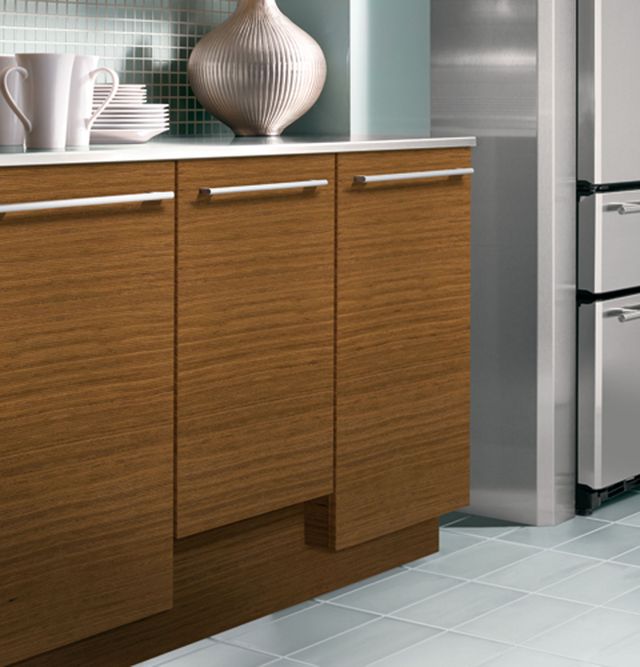
The cabinet drawings came back approved, the doors are ordered, and then the cabinet maker asks one question nobody planned for: what are the panel dimensions, the maximum weight, and the handle drilling locations for the dishwasher. Nobody has that sheet, because nobody has picked the dishwasher yet. That single gap is how a kitchen ends up with a beautiful run of doors interrupted by a wide stainless rectangle beside the sink, or a panel ready dishwasher sitting in a garage for six weeks while a second panel gets built to the right spec. The appliance decision drives the cabinet order, not the other way around, and it needs to happen early.
Plan the Panel and the Dishwasher Together
Our team pulls spec sheets and panel templates before you order, then handles delivery, professional installation, and local service across central Wisconsin. Shop online or compare integrated models in person at a showroom near you.
Explore panel ready dishwasherHere is the good news buried in all of that: every number the cabinet maker needs is published, free, and available before you spend a dollar. At Furniture & ApplianceMart, our team works through these specs with homeowners and builders across the Wausau, Stevens Point, Wisconsin Rapids, Marshfield, and Appleton areas, so we know which details decide whether a finished install looks custom or looks close. This guide covers how these units actually work, the sizes and cabinet opening dimensions you need, panel thickness and weight limits, the features worth paying for, what installation really involves, and how to sequence the order so the panel and the cabinets arrive together.
Key Takeaways
- The panel is never included: A panel ready dishwasher ships without a front, a handle, or a toe kick trim piece, so those three items come from your cabinet maker and hardware supplier as separate line items.
- Weight is the spec that gets skipped: Door springs are factory-set for a mid-range panel, commonly somewhere near 11 to 18 pounds, and the tension has to be readjusted to your actual panel or the door will slam open or spring shut.
- Depth fails more installs than width: Usable cabinet depth of roughly 21 and five-eighths to 23 inches gets eaten by countertop overhang, thick backsplash tile, and new flooring, and a fully integrated door with a panel on it needs more room than a stainless front.
- Order the panel with the cabinets: Panels follow the cabinet lead time and rarely match across brands or model generations, so the dishwasher gets chosen early in a remodel and the model number gets saved for later.
What Is a Panel Ready Dishwasher and How Does It Work
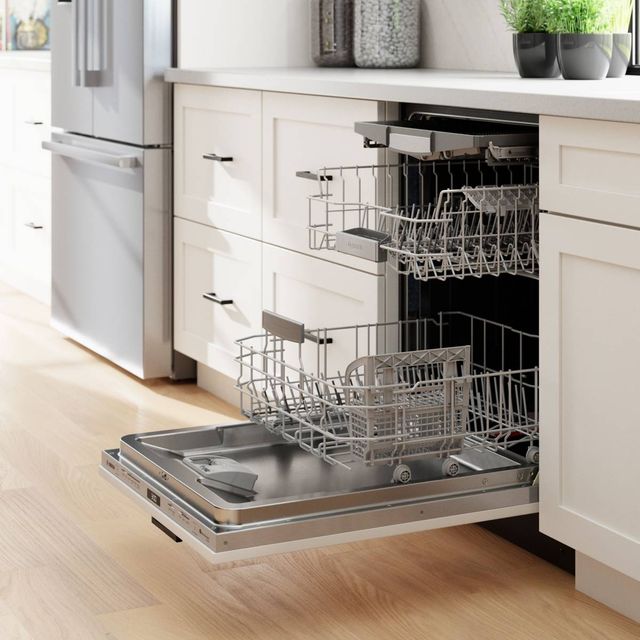
A panel ready dishwasher is a built-in dishwasher shipped without a finished front, designed to accept a custom cabinet door panel so the appliance disappears into the surrounding cabinetry. Instead of a stainless or black steel face, you get a bare door frame with mounting hardware, and the visible surface becomes a door built by the same shop that built everything else in the room.
The mechanics are straightforward once you see them laid out. The unit arrives with mounting brackets, a paper or cardboard template that marks the screw locations, and a door spring system sized to carry the added weight of a wood panel. The panel gets fastened through the door frame using the template, and the springs get tensioned to match what the panel actually weighs. That tension adjustment is the part that turns a heavy door into one that opens smoothly and stays where you put it.
What Does Not Come in the Box
This is the single most common misunderstanding, so it is worth stating plainly. A panel ready dishwasher does not include the panel, the handle, or the toe kick trim. The manufacturer builds the machine; your cabinet maker builds the front. Handles typically come from the same hardware line as the rest of your kitchen pulls, and the toe kick strip is usually a matching piece of cabinet material cut to fill the gap at the base.
The Terminology Different Brands Use
Shopping gets confusing because manufacturers name the same idea five different ways. These terms show up across spec sheets and product pages:
- Panel ready: the general category, meaning the unit accepts a custom front.
- Custom panel or custom panel ready: the same thing, usually on higher-end brands.
- Fully integrated: controls hidden on the top edge of the door, so nothing shows when the door is closed.
- Semi-integrated: a custom panel with a visible control strip or display band above it.
- Integrated dishwasher panel: the door itself, the piece your cabinet shop makes.
Who Actually Buys One
Integrated dishwashers show up in specific projects rather than routine replacements. Full kitchen remodels with new cabinetry lead the list, followed by custom cabinet projects where the run is meant to read as furniture. Minimalist and hidden-appliance designs rely on them almost by definition. Kitchen islands and butler pantries are the other big use case, because those spaces sit in sight lines where a stainless face would stand out.
Read more:
Bosch Dishwasher Series Explained
Best Sub-Zero Refrigerator Models for Luxury Kitchens
Panel Ready vs Standard Stainless vs Fully Integrated Dishwashers
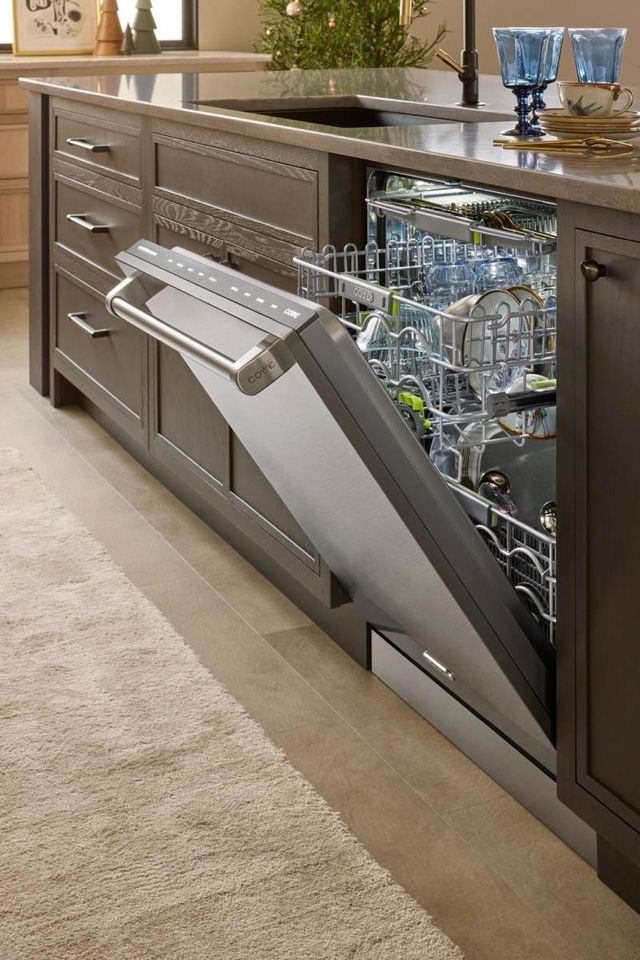
Three design styles cover almost everything on the market, and the differences come down to what shows on the front of the door.
A standard finished-front model arrives with a stainless, black stainless, or white face, and it is ready to install the day it lands. A semi-integrated model takes a custom panel but keeps a visible control band above it, so you still see a strip of appliance in the cabinet run. A fully integrated model puts every button and readout on the top edge of the door, which means a closed door shows nothing but your cabinet panel and your handle.
The Distinction Most Guides Get Wrong
A top control dishwasher with a stainless front is not a panel ready dishwasher. Both hide the buttons on the top edge, but one still wears a factory metal face, and that face is exactly what an integrated kitchen is trying to get rid of. Read the model description carefully, because top control and panel ready describe two different things that often appear in the same product name.
The same goes for semi-integrated units. They take a custom panel, which sounds fully hidden, but the control strip above the panel still reads as an appliance from across the room.
What Hidden Controls Change Day to Day
Burying the controls has real consequences, some good and some annoying:
- No at-a-glance display, so you cannot see time remaining without opening the door.
- Changing a cycle mid-wash means pulling the door open and interrupting the run.
- Small children cannot reach or press the buttons on a closed door, which is a genuine safety benefit.
- Many fully integrated models project a light beam or a time display onto the floor so you can tell the unit is running.
- Some models use a status light on the door edge or an audible end-of-cycle tone instead of a screen.
If the idea of not seeing a countdown bothers you, a semi-integrated model with a visible strip is the honest middle ground. If you want the cabinet run uninterrupted, accept the floor beam and move on.
Panel Ready Dishwasher Sizes and Cabinet Opening Dimensions
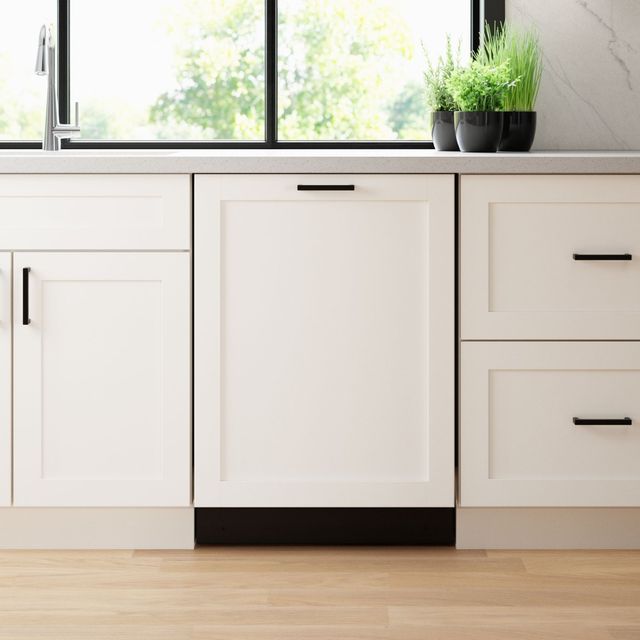
Panel ready dishwasher sizes are simpler than most categories. There are two mainstream widths and one specialty format.
Full-size units are 24 inches wide and handle the dishes for a typical household. Compact units are 18 inches wide and give up capacity for width, which makes them right for condos, cabins, small kitchens, and second-dishwasher duty. Panel ready drawer dishwashers are the third option, splitting into two independently running drawers, each of which needs its own matched panel.
The Rough Opening Numbers
A standard 24-inch cutout is roughly 24 inches wide, about 34 to 34 and a half inches tall, and around 24 inches deep. An 18-inch unit uses the same height and depth with a narrower width. Those are starting points only; the spec sheet for your exact model is the number cabinetry gets built from.
Depth deserves extra attention because fully integrated panel ready models often run deeper than finished-front units. The panel adds thickness to the door, and that thickness has to live somewhere. Usable cabinet depth commonly falls between about 21 and five-eighths inches and 23 inches once you account for the plumbing behind the unit, and a deep countertop overhang or a thick tile backsplash can push the machine forward until the panel no longer lines up with the cabinet faces beside it.
The Flooring Detail Competitors Miss
New flooring reduces the opening height. Luxury vinyl plank, engineered hardwood, and especially tile with a mortar bed all raise the floor deck under the dishwasher, and a unit that fit the subfloor measurement can end up trapped under the countertop with no room to level. Measure to the finished floor height, not the subfloor, and if the flooring runs under the cabinets, confirm it also runs under the dishwasher opening. A machine set on plywood while the surrounding floor sits three-eighths of an inch higher will never align with the cabinet doors.
Toe Kick and Plinth Planning
Panel ready installs almost always call for a matching removable toe kick strip. The dishwasher itself has a base with an access panel behind it, and a plain factory kick plate will not match the cabinet run. Your cabinet maker cuts a strip from the same material, and it gets attached so it can still come off for service. Height matters here too, since the strip has to align with the toe kick on the cabinets to either side.
How to Measure Your Opening
- Measure the opening width at the front and the back, then use the smaller number.
- Measure height from the finished floor to the underside of the countertop in three places across the opening.
- Measure depth from the back wall to the front face of the adjacent cabinet doors, not to the cabinet box.
- Note the countertop overhang and any backsplash thickness that intrudes into the opening.
- Confirm the floor is level side to side so the unit can be shimmed without losing height.
- Check that the water supply, drain, and electrical are positioned inside the manufacturer’s specified zone at the rear.
- Compare all six numbers to the spec sheet for the exact model number you plan to buy.
Panel Ready Dishwasher Comparison: Sizes, Controls, and Panel Requirements
Read across the row that matches what you are considering, then confirm every figure against the manufacturer spec sheet before cabinetry is built.
| Dishwasher Type | Typical Width | Control Style | Panel Requirement | Best For | Key Consideration |
|---|---|---|---|---|---|
| 24-Inch Fully Integrated Panel Ready | 24 inches | Hidden on top edge of door | Single full-height door panel | Custom kitchens where the machine disappears | Often needs a deeper cabinet cutout than a stainless model |
| 24-Inch Semi-Integrated Custom Panel | 24 inches | Visible strip above the panel | Panel below a visible control strip | Buyers who want cycle status without opening the door | The control band interrupts the cabinet face |
| 18-Inch Compact Panel Ready | 18 inches | Usually hidden on the top edge | Narrower single panel | Condos, cabins, and second dishwashers | Fewer place settings per cycle than full-size |
| Panel Ready Drawer Dishwasher | 24 inches total | Top edge of each drawer | Two matched drawer panels | Islands and small split loads | Two panels and two handles raise panel cost |
| Standard Stainless Built-In | 24 inches | Front or top control | No panel needed | Straight replacements and tight budgets | Lowest total installed cost of the group |
A few things the table is really telling you:
- The width decision is a capacity decision. Going from 24 inches to 18 inches costs you place settings, so compact units work best as second machines or in households that run smaller loads.
- Every step toward a fully hidden front adds coordination, not just money. Panels, handles, and toe kicks all become someone else’s lead time.
- Drawer models double the panel work. Two doors means two panels, two handles, and two chances for a finish mismatch.
Custom Dishwasher Panel Specs: Weight Limits, Thickness, and Handles
Most buying guides talk about panels as if any cabinet door will do. It will not, and the reason is weight.
The Custom Dishwasher Panel Weight Limit
Every panel ready dishwasher publishes an acceptable panel weight range, commonly somewhere around 7 to 24 pounds depending on the model and the door mechanism. Units usually ship pre-set from the factory for a mid-range panel, often in the neighborhood of 11 to 18 pounds, which means the door spring tension has to be adjusted once your real panel is hung.
Get it wrong and you will know immediately. A panel that is heavier than the spring setting makes the door drop open and land hard, and over time that abuse works on the hinge and the door seal. A panel that is lighter than the setting makes the door spring back toward closed instead of resting flat, so the racks will not stay out while you load them. Neither is a defect. Both are a spring adjustment nobody made.
Thickness, Height, and Construction
Panel thickness is typically three-quarters of an inch, matching standard cabinet door stock, which is why a panel usually comes out of the same run as the rest of the doors. Maximum overall panel height is limited by the mounting template, so the panel cannot simply be sized to fill the visual gap; it has to land inside the manufacturer’s dimensions.
Material choice matters more in Wisconsin than it does in a lot of the country. Solid wood panels expand and contract through a heating season that swings from humid August to bone-dry January, and a panel that fits with even reveals in September can bind or open a gap by February. MDF cores and slab panels stay more dimensionally stable through those swings. Grain direction should also run the same way as the doors on either side, because a vertical-grain dishwasher panel in a run of horizontal-grain doors is the first thing a guest notices without knowing why.
Handles Are Part of the Weight
Fully integrated models need a pull handle mounted through the panel, and that handle counts toward the total weight the door has to carry. Pick the handle before the panel is drilled, not after. Drilling a finished panel a second time because the pull spacing changed is a new panel, not a repair. Handle placement also has to clear the countertop edge above and the toe kick below through the full door swing.
One instruction is worth repeating to anyone doing this: hand the manufacturer’s panel template and spec sheet to the cabinet maker before a single panel is cut. Not the marketing brochure, not the product page, the actual spec sheet with the model number on it.
Panel Ready Dishwasher Features Worth Paying For
Once the fit is settled, features decide how the machine lives with you. Some matter more specifically because the unit is hidden.
Sound Rating
Sound is measured in decibels, and lower is quieter. Ratings in the mid-40s and below are effectively inaudible in a working kitchen, and that matters most in open-concept homes where the kitchen shares air with the living room. There is a second reason to care in an integrated kitchen: without a visible display, sound is often the only clue the machine is running, so a very quiet unit paired with no status indicator can leave you guessing.
Drying Technology
Drying separates good dishwashers from frustrating ones, especially with plastics and stemware:
- Condensation drying uses a stainless tub and residual heat, with no exposed heating element.
- Fan-assisted drying pushes air through the tub to speed the same process.
- Heated drying uses an element and dries fastest, though it is harder on plastics.
- Zeolite mineral drying absorbs moisture and releases heat, finishing plastics better than condensation alone.
- Auto-open door drying cracks the door at the end of the cycle to vent steam, which works well but does swing your custom panel open a few inches.
Interior and Capacity
Look for a stainless steel tub, a third rack for utensils and small items, adjustable and fold-down tines, and a dedicated cutlery tray. Place-setting capacity is where compact units pay the price for their width, so a household that runs full loads daily should think hard before choosing 18 inches as the only dishwasher in the house.
Cycles, Sensors, and Protection
The features people actually use are less glamorous than the brochure suggests:
- Soil sensors that adjust water use and cycle length to the actual load.
- A sanitize cycle, ideally NSF certified, for bottles and cutting boards.
- Quick or express cycles for a lightly soiled load before company arrives.
- Delay start for running overnight on off-peak hours.
- Leak protection systems that shut off the water supply automatically.
- Automatic detergent dispensing and app connectivity for cycle status on your phone.
- ENERGY STAR certification and low water use per cycle, which lower operating cost over a decade of ownership.
The Features That Matter Because It Is Hidden
Three items go from nice-to-have to genuinely useful once nothing shows on the front. An audible end-of-cycle signal tells you the load is done without a display. A floor projection light or door-edge indicator tells you the unit is running before you open it mid-cycle. Interior lighting helps when the door swings open into a dark cabinet run, which happens more than you would think in an island installation.
Panel Ready Dishwasher Installation Requirements and Prep Checklist
Panel ready dishwasher installation is a two-trade job. There is the appliance work, and there is the cabinetry fitting, and the finished result is judged entirely on the second one.
The Sequence, In Order
- Confirm the rough opening width, height, and depth against the spec sheet.
- Verify the finished floor height, including any flooring going in under the unit.
- Run the hot water supply line and the drain line into the manufacturer’s specified rear zone.
- Confirm the electrical connection type, whether hardwired or cord-connected, on a dedicated grounded circuit.
- Slide the unit into the opening and check clearance to the cabinet sides as it goes.
- Level the machine and shim the feet so the door frame sits square in the opening.
- Attach the mounting brackets to the underside of the countertop or the side cabinets, per the model.
- Install the custom panel using the manufacturer’s template and supplied hardware.
- Adjust the door spring tension to the actual weight of the installed panel.
- Mount the handle, then fit and attach the matching toe kick strip.
- Run a full cycle and check for leaks at both the supply and the drain connection.
Utilities in Plain Terms
Plan on a dedicated grounded circuit sized to the model’s specification, a hot water supply line with an accessible shutoff, and a drain connection with a high loop or an air gap depending on local code. Here is the one detail our installation crews never skip: the drain hose high loop gets fastened to the underside of the countertop as high as it will go, generally around 20 inches above the floor, because a loop that sags below the sink drain lets dirty water siphon back into the tub and leaves standing water at the bottom of every cycle.
Alignment Is the Whole Job
Once the panel is on, the reveal gaps at the top, the bottom, and both sides have to match the gaps on the cabinet doors next to it. The panel also has to sit in the same plane as the cabinet faces rather than proud of them. A panel standing an eighth of an inch forward of its neighbors catches light along its edge and reads as wrong from across the room even to people who cannot say what is bothering them.
Three Mistakes That Cost Real Money
- Ordering the panel before the dishwasher model is finalized. Templates are model-specific, and a panel cut to the wrong template is scrap.
- Forgetting to retension the door spring after the panel is hung. This is the number one call we get about a door that slams or will not stay open.
- Ignoring countertop overhang and backsplash depth. Both steal the depth the panel needs to sit flush.
Most manufacturers will not warranty a panel installed outside their published spec, which is a good reason to have this handled by people who do it regularly. Furniture & ApplianceMart offers professional installation and local in-house service across central Wisconsin, so the spec sheet gets checked before the order, the panel gets hung to the template, and there is someone nearby if the door needs a spring adjustment next spring.
What a Panel Ready Dishwasher Costs and How to Plan the Order
Panel ready dishwasher cost is not one number, and the shoppers who get surprised are the ones who only budgeted for the appliance.
The Five Line Items
- The dishwasher itself, which generally carries a premium over a comparable finished-front model.
- The custom panel from your cabinet maker, priced like any other door in the run.
- The handle, which comes from your hardware line and is not included.
- The toe kick trim strip, cut and finished to match.
- Professional installation labor, which covers both the appliance set and the panel fitting.
The custom panel is the line item most shoppers do not see coming. It is not an appliance charge and it will not appear on your appliance quote, so ask your cabinet shop to price it when the rest of the doors are quoted.
The Ordering Timeline
- Choose the exact model, down to the model number.
- Obtain the spec sheet and the panel template from the manufacturer or from your retailer.
- Share both with the cabinet maker before shop drawings are approved.
- Order the panel with the cabinet run so the species, stain, and finish batch all match.
- Schedule delivery and installation after the cabinets are set and the countertop is in.
Lead time is the reason this sequence is not optional. Custom panels follow the cabinet order schedule, which is often measured in weeks, so the dishwasher decision belongs at the front of a remodel rather than the end.
Plan for the Replacement You Will Need Later
Here is the part almost nobody covers. Panels are generally not interchangeable between brands, and frequently not even between model generations of the same brand, because the template hole pattern and the maximum dimensions change. When your dishwasher is replaced in eight or ten years, the new machine may need a new panel.
Two habits make that future easier. Save the model number, the spec sheet, and the panel template with your home records. And think about the finish, since a stained wood panel built to match ten-year-old cabinets is a color-matching exercise, while a painted or laminate slab panel is usually easier to reproduce.
Integrated kitchen design does hold value. A cabinet run without an appliance face breaking it up presents well when a home is listed, and buyers notice cohesive kitchens. That is a real benefit, just not one worth overstating on an appraisal.
The format buys you a specific look and costs you specific flexibility. Both halves are real, and which one matters more depends on whether you are building a kitchen or replacing a machine in one.
Pros
An uninterrupted cabinet run
The dishwasher stops reading as an appliance and becomes another door in the row, which is the entire point of an integrated kitchen.
Design flexibility across any finish
Because the front comes from your cabinet shop, you are not limited to whatever finishes the appliance brand offers this year.
Typically quieter construction
Fully integrated models tend to sit in higher tiers with better insulation, and the added mass of a wood panel on the door helps too.
Long-term visual cohesion
As the kitchen ages, a panel that matches the cabinets ages with them instead of dating itself to a specific appliance finish trend.
Cons
A higher total project cost
The appliance premium, the custom panel, the handle, the toe kick, and the added labor all land on the same project budget.
More coordination and less flexibility later
Three parties have to agree on specs up front, and a future replacement may need a new panel to match an aging cabinet finish.
Read more:
Exploring Different Types of Kitchen Vent Hoods
8 Double Oven Features Home Cooks Love
The Panel Weight Worksheet That Prevents a Slamming Door
Door spring tension is the one specification you cannot eyeball, and it is set against a number almost nobody measures: the finished weight of everything bolted to that door frame. The manufacturer publishes a range, the factory ships the unit set near the middle of it, and the installer either matches the real weight or does not. The fix is unglamorous. Before the panel leaves the cabinet shop, have it weighed as it will be installed, on a bathroom scale if that is what is handy, and write that number on the back of the panel in pencil. Then hand it to whoever is installing the dishwasher along with the spec sheet. Total the following, because all of it hangs on the same springs:
- The panel slab itself, in its final thickness and with its finish applied.
- The handle or pull, including mounting bolts, which can add real weight in solid brass or heavy steel.
- Any applied molding, edge banding, or decorative frame added to the face.
- Mounting brackets and screws supplied with the dishwasher, if the manual counts them.
- Any adhesive-backed backing plate a cabinet shop adds for stiffness on a wide panel.
Read more:
Top Electric Ranges With Convection, Air Fry, & Smart Features
Why Furniture & ApplianceMart Stands Out Among Furniture Stores in Milwaukee
Top Panel Ready Dishwashers Available at Furniture & ApplianceMart
The lineup below splits three ways by width and three ways by how much of the machine you want to see. Three are full-size 24-inch units for a primary kitchen, and three are 18-inch compacts for tighter spaces and second-dishwasher duty. Our showrooms across central Wisconsin let you see door action, rack layouts, and panel mounting hardware in person, and our specialists can pull the spec sheet and the panel template for any model here before you commit cabinetry to a plan.
Cove 24” Panel Ready Top Control Built-In Dishwasher

Cove is the dishwasher side of the Sub-Zero and Wolf family, which makes this the model to specify when the rest of the kitchen is already at that tier. The controls live on the top edge of the door, so a closed door shows nothing but your cabinet panel and your chosen handle. Give the panel template to the same shop building the cabinet run, order the panel in the same finish batch, and have the door spring retensioned once the finished panel is hung. Reveals on all four sides should match the doors beside it exactly.
Top Features
- Full 24-inch capacity: Handles a primary kitchen workload rather than serving as a supplemental machine.
- Top-edge controls: Nothing interrupts the cabinet face when the door is closed, which is the hidden-appliance look done properly.
- Single full-height panel: One door panel from your cabinet shop, ordered against the manufacturer template.
- Luxury-tier pairing: Matches naturally with Sub-Zero and Wolf equipment in a fully specified custom kitchen.
Monogram 18” Panel Ready Built-In Dishwasher

When the kitchen is 90 square feet and every inch of base cabinet is spoken for, 18 inches is the difference between having a dishwasher and not. This Monogram compact takes a narrower custom panel and disappears into a condo or small-home cabinet run the same way a full-size unit does. The narrow door needs the same attention to grain direction discussed earlier, since a slim panel makes a mismatched grain more obvious, not less. Expect fewer place settings per load than a 24-inch machine, which is the honest trade for the 6 inches you get back.
Top Features
- 18-inch compact width: Frees up half a base cabinet in a kitchen where floor space is the limiting factor.
- Narrower single panel: One panel to order, cut to the compact template rather than the full-size one.
- Monogram build quality: A premium integrated line rather than a stripped-down small-space appliance.
- Grain matching matters more: A slim panel sits between two doors, so direction and stain should be specified carefully.
Bosch 800 Series 24” Panel Ready Top Control Built-In Dishwasher

The 800 Series is the quiet mainstream answer for an open-concept great room where the kitchen shares air with the couch. Controls sit on the top edge of the door, so the front stays clean, and Bosch panel mounting hardware is well documented for installers. This is the model to look at when you want integrated cabinetry without stepping into the highest price tier. Plan for the same panel weight check covered earlier, since the door spring arrives set for a mid-range panel and your cabinet shop’s door may not land there.
Top Features
- Quiet operation for open rooms: Built for kitchens that open onto living space, where dishwasher noise carries.
- Top control layout: Buttons on the top edge keep the closed door free of any control face.
- Mainstream integrated pricing: Integrated looks without committing to the luxury tier of the category.
- Well-documented panel hardware: Templates and mounting instructions that cabinet installers work with regularly.
Electrolux 18” Panel Ready Built-In Dishwasher
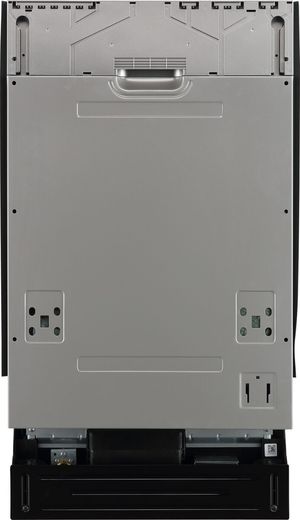
A second dishwasher changes how a kitchen works during holidays, and 18 inches is the width that usually fits. Drop this Electrolux into an island or a butler’s pantry and run glassware in it while the main unit handles plates. Because island and pantry cabinetry sits in the open, the hidden front is doing real work here rather than just looking tidy. Confirm the water and drain routing early, since an island install means running lines through the floor rather than along a back wall, and that decision happens before the slab or the subfloor is closed up.
Top Features
- Second-dishwasher width: Fits an island or a pantry run where a 24-inch cabinet is not available.
- Panel ready front for open sight lines: Islands are visible from every direction, so a hidden front pays off.
- Splits the load: Keeps glassware and small loads separate from the main machine during entertaining.
- Plan utilities early: Island installs need supply and drain routed under the floor before finishes go in.
GE Profile 18” Panel Ready Built-In Dishwasher
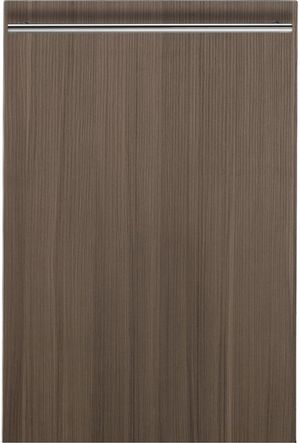
Cabins, lake places, and apartment kitchens run smaller loads and often have odd cabinet layouts left over from a previous decade. This GE Profile compact fits an 18-inch opening and takes a custom panel, which lets a modest kitchen look intentional instead of pieced together. Pay close attention to finished floor height in an older cabin, where flooring has often been added over flooring and the opening is shorter than the original build. A matching removable toe kick strip finishes the base so the unit reads as cabinetry rather than an appliance tucked into a gap.
Top Features
- Fits older, tighter openings: An 18-inch cutout works in cabin and apartment kitchens where 24 inches never existed.
- Custom panel front: Lets a small or dated kitchen present as a continuous cabinet run.
- Watch the floor height: Layered flooring in older buildings eats opening height, so measure to the finished surface.
- Toe kick strip finishes the base: A matching removable strip hides the machine’s base and stays serviceable.
Monogram 24” Panel Ready Fully Integrated Dishwasher
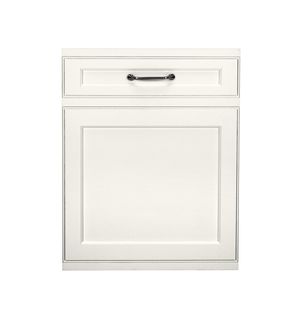
This is the version where nothing shows at all. Fully integrated means the entire control face lives on the top edge of the door, so a closed door is a cabinet door and nothing else, which is exactly what a minimalist or hidden-appliance kitchen is after. Full 24-inch capacity means it can carry a household on its own rather than assisting another machine. Since there is no display to glance at, decide up front how you want to know the cycle is running, whether that is an end-of-cycle tone or a floor indicator, and confirm it on the spec sheet.
Top Features
- Completely hidden control face: No buttons, no strip, no display interrupting the front of the cabinet run.
- Full-size 24-inch capacity: Sized to be the only dishwasher in a working household kitchen.
- Single full-height door panel: One panel and one handle, both ordered against the Monogram template.
- Confirm your status indicator: With no visible screen, an audible signal or floor light is how you know it is running.
Bring Your Kitchen Together With the Right Panel Ready Dishwasher
Verify the opening in all three dimensions with special attention to depth and finished floor height, hand the panel template and weight limit to your cabinet maker before anything is cut, choose features around the fact that the machine is hidden, and order the panel alongside the cabinet run so the finishes match. Those four steps cover nearly every problem this category creates. The rest is a matter of picking the width and the control style that suit how you cook.
Bring your measurements and your cabinet drawings to Furniture & ApplianceMart. Shop panel ready dishwashers online or visit a showroom in the Wausau, Stevens Point, Wisconsin Rapids, Marshfield, or Appleton area, where our appliance specialists can pull spec sheets and panel templates, compare models side by side, and help you sequence the order with your cabinet schedule. Our own crews handle delivery and professional installation, and our in-house service department is right here in central Wisconsin if that door ever needs an adjustment. That combination of hands-on guidance, local installation, and after-the-sale support is what an independent Wisconsin retailer offers that a warehouse order and a call center cannot.
Frequently Asked Questions about Panel Ready Dishwashers
No, a panel ready dishwasher never includes the custom panel, and it usually does not include the handle or the toe kick trim either. Those pieces come from your cabinet maker and hardware supplier so they match the surrounding cabinetry exactly.
Most panel ready dishwashers accept a panel somewhere in the range of about 7 to 24 pounds, with the exact limit published on the model’s spec sheet. The door spring ships set for a mid-range weight, so it has to be retensioned to your actual panel or the door will slam open or spring closed.
Panel ready dishwashers come primarily in 24-inch full-size and 18-inch compact widths, plus drawer models that use two separate matched panels. A standard cutout runs roughly 24 inches wide, about 34 to 34 and a half inches tall, and around 24 inches deep, though the model spec sheet is the number cabinetry should be built from.
No, panels are generally not interchangeable between brands and frequently not between model generations of the same brand. Template hole patterns and maximum panel dimensions differ, so a replacement dishwasher often needs a newly built panel.
No, only dishwashers manufactured as panel ready models can accept a custom cabinet panel, because they ship with the door frame, brackets, and adjustable spring system required. Attaching a wood panel to a standard finished-front dishwasher overloads the door mechanism and voids the warranty.
A confident do-it-yourselfer can set and level the unit, but the panel fitting, spring tensioning, and reveal alignment are cabinetry work that decides how the finished install looks. Manufacturers also decline warranty coverage on panels installed outside their published spec, which is why professional installation is the safer route.
Why Trust Furniture & ApplianceMart?
For over 55 years, Furniture & ApplianceMart has proudly served Wisconsin and Illinois as a local, employee-owned retailer built on family values and long-term relationships. What began as a customer-first business has grown into the area’s only true one-stop shop for furniture, appliances, and mattresses.
Our mission is to improve the quality of people’s lives by making amazing rooms together. We offer trusted national brands, competitive pricing, and flexible financing options for every budget to make furnishing your home simple and stress-free. We service what we sell with repairs completed by skilled, in-house technicians you can rely on. With a meet or beat price guarantee and a commitment to exceptional service after the sale, we stand behind every purchase.
Shop at Furniture & ApplianceMart
At Furniture & ApplianceMart, you’ll find a wide selection of furniture at competitive prices. From custom furniture to top-brand mattresses and major appliances, we make it easy to shop for everything you need in one store. Ask about clearance and scratch-and-dent savings available at every location, professional delivery and installation, design consultations, appliance repair services, and convenient financing options. Visit one of our showrooms across Wisconsin and Illinois or shop online today.