

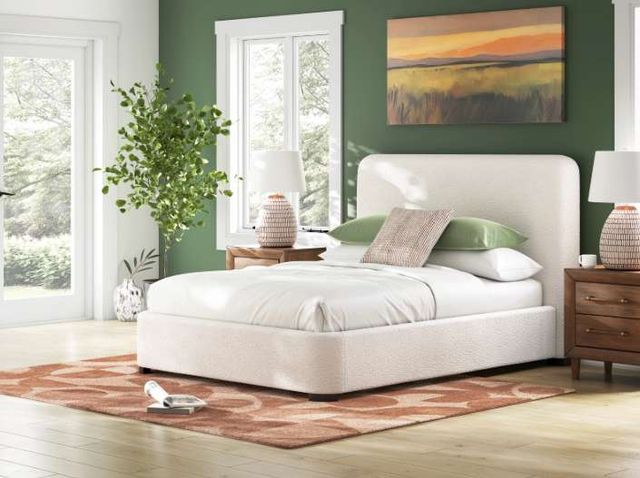
At six foot four, the arithmetic of a standard bed stops being abstract around two in the morning. Heels hang past the end of the mattress, the comforter pulls up off the feet, and the cold that creeps in around the ankles is enough to surface a person out of deep sleep two or three times a night. Adding a blanket does not fix it, because the problem is not warmth, it is length. A california king mattress exists for exactly this sleeper, and understanding what it does and does not add is the difference between a genuine upgrade and an expensive lateral move.
The relief here is that this decision has clean, measurable answers rather than opinions. At Furniture & ApplianceMart, our showrooms across the Wausau, Stevens Point, Wisconsin Rapids, Marshfield, and Appleton areas let you lie down in your actual sleep position for as long as you need, and our team will walk through room measurements and delivery paths with you before anything is ordered. This guide covers the exact dimensions, how this size compares with a standard king, whether it fits your bedroom, mattress types and firmness, foundations and adjustable bases, the total cost of switching sizes, and how to make the mattress last.
Find the Bed Size That Finally Fits Your Body and Your Room
Our sleep team helps central Wisconsin shoppers match firmness, construction, and bed size to real bedrooms and real sleep positions every week. Shop mattresses, bed frames, adjustable bases, and complete bedroom sets with delivery, in-home setup, and old mattress removal handled by our own crews.
Explore california king mattress optionsKey Takeaways
- Longer, not bigger: A california king mattress measures roughly 72 by 84 inches while a standard king measures roughly 76 by 80 inches, so you trade four inches of width for four inches of length at nearly identical total surface area.
- The room shape matters as much as the room size: A narrower, longer footprint often fits a long rectangular bedroom better than a standard king does, which is the opposite of what most shoppers assume.
- Bedding is the forgotten line item: Sheets, protectors, and comforters in this size cost more and are stocked in fewer places, and standard king sheets will not fit.
- The base is part of the purchase: Slat spacing, center support, and foundation type affect both comfort and warranty coverage, so the frame is not an afterthought.
California King Mattress Dimensions and Who It Is Built For
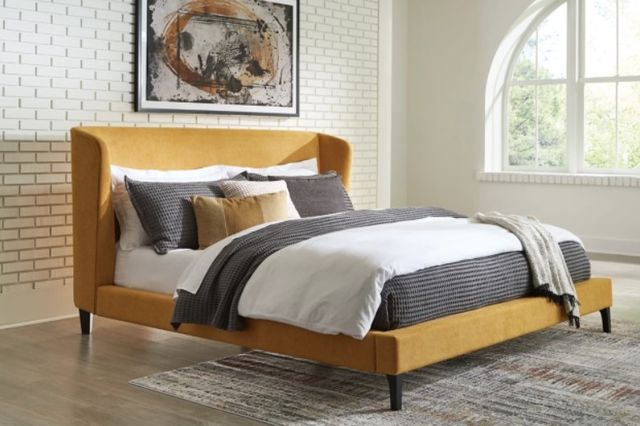
A california king mattress measures approximately 72 inches wide by 84 inches long. A standard king measures approximately 76 inches wide by 80 inches long. That is the entire difference, and it is worth stating plainly because most people expect the California version to be the larger bed.
It is not. Run the numbers and both sizes land right around 6,000 square inches of surface, within about 1 percent of each other. The California king is longer and narrower. The standard king is wider and shorter. Neither one is bigger.
Who the Extra Four Inches Genuinely Serves
- Sleepers around six feet and taller, especially back and stomach sleepers whose bodies lie fully extended rather than curled.
- Anyone who sleeps with feet past the end of the mattress, which causes both cold feet and comforter tug-of-war.
- Households where a dog sleeps at the foot of the bed, since the extra length is usable space rather than contested space.
- Couples where one partner is significantly taller, because the length benefits both sides without either giving anything up.
Who Is Better Served by a Standard King
The narrower width is a real cost. Couples who share the bed with young children or a large dog sleeping crosswise, and couples who want maximum personal space side to side, will feel those four inches. Each person on a California king gets about 36 inches of width, which is roughly a twin mattress each. On a standard king, each gets 38.
Split California king is worth knowing about here. Two separate mattresses, each about 36 by 84 inches, sit side by side inside one frame. That configuration is what makes independent adjustable base positioning possible, and it also lets two partners with genuinely different firmness needs each get what they want in one bed.
Before you decide, run a measurement tonight. Lie down the way you actually sleep, have someone measure from the crown of your head to the soles of your feet, then add the pillow depth you use and about two inches of headboard allowance. If that number crosses 80 inches, you have your answer.
Will a California King Fit Your Bedroom
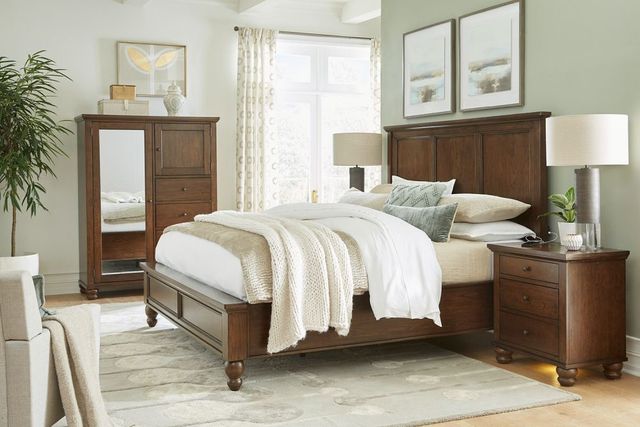
Room planning at this size is arithmetic, not instinct.
Leave roughly 24 inches of walking clearance on each open side of the bed as a minimum, with 30 to 36 inches feeling genuinely comfortable. Apply that to a 72 by 84 inch mattress and the practical minimum bedroom works out to about 12 by 12 feet, with 12 by 14 feet or larger being where the room stops feeling crowded.
Here is the distinction most guides skip: because this size is narrower and longer, it frequently works better in a long, narrow bedroom than a standard king does. Put the headboard on the short wall of a room that runs long, and the four inches you gave up in width become four inches of walking room on both sides.
Then account for everything else competing for that floor:
- Nightstands, which need about 24 inches of width each
- A dresser, and the drawer pull-out depth in front of it
- A bench or trunk at the foot, which eats into the walkway
- Closet and bathroom door swings, since a door that hits the bed frame is a daily annoyance
- A clear path to windows and to any light switch
Tape the footprint on the floor before you buy. Use painter’s tape to mark 72 by 84 inches, then add the frame and headboard, which typically extend two to five inches beyond the mattress on each side and several inches at the head. Live with the tape for a day and walk the room in the dark.
Delivery deserves its own attention at this size. A one-piece mattress this large is heavy and awkward and does not bend around a corner. Measure doorway widths, hallway turns, stair landings, and any low ceiling at the bottom of a staircase. Some models arrive compressed in a box, which solves the path problem entirely, and knowing which type you are buying changes what is possible in an older home.
Choosing the Right Mattress Type and Firmness
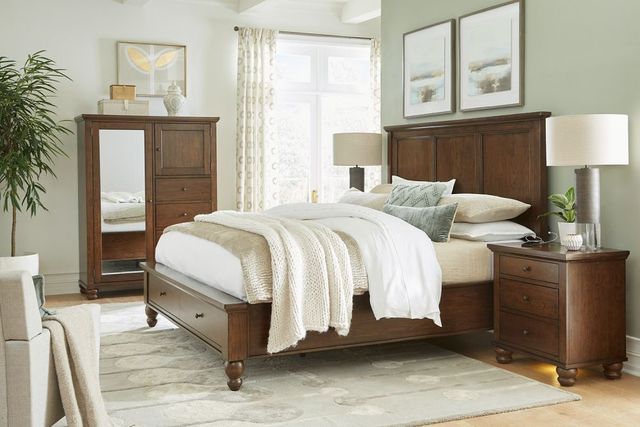
Size decides fit. Construction decides whether you sleep well.
Read more:
Bed Frame Questions Every Shopper Should Ask Before Buying
Comparing Hybrid Mattress vs Memory Foam: Which is Better?
The Main Construction Types
- Innerspring: Coil support with a thin comfort layer. Bouncy, breathable, and strong on edge support, but the weakest at motion isolation. Typically the shortest lifespan.
- Memory foam: Contours closely to the body and absorbs motion better than anything else, which matters on a shared bed. Sleeps warmer unless it has cooling features built in.
- Latex: Responsive and buoyant rather than sinking, naturally more breathable than memory foam, and generally the longest-lasting material. Priced accordingly.
- Hybrid: A coil support core topped with foam or latex comfort layers. The most common premium construction because it balances support, motion isolation, and airflow.
- Adjustable air: Chambers inflate to a chosen firmness, usually with independent control per side. The most adjustable option and the most mechanically complex.
Firmness and Sleep Position
Firmness runs on a practical scale from soft to firm, and sleep position points to a range:
- Side sleepers generally need softer to medium, because the shoulder and hip need somewhere to sink.
- Back sleepers generally need medium to medium-firm, enough give for the lower back to stay supported without the hips dropping.
- Stomach sleepers generally need firmer, since a soft surface lets the hips sink and pulls the lower back into an arch.
Body weight changes perceived firmness, which is why a mattress two partners test together can honestly feel different to each of them. A heavier person compresses the comfort layers further and reaches the support core sooner, so the same bed reads softer to them than to a lighter partner.
The Two Properties That Matter Most on a Shared Bed
Motion isolation and edge support. A wide bed can still sleep badly if every turn transmits across it, and edge support decides whether the outer eight inches of the mattress are usable sleeping surface or just a place to sit while putting on socks.
Cooling deserves an honest read. Gel infusions help modestly. Phase change cover materials feel cool to the touch on contact and that effect diminishes as the night goes on. Coil airflow in a hybrid or innerspring does more for temperature than any surface treatment. Dense all-foam constructions sleep warmest.
Test properly in the showroom. Lie in your primary sleep position for at least ten minutes, with a pillow of the height you actually use. Sitting on the edge for thirty seconds tells you nothing about how a mattress sleeps.
For couples with mismatched preferences, split California king with an adjustable base solves the problem structurally rather than through compromise. Each side gets its own mattress firmness and its own head and foot articulation.
Foundations, Frames, and Adjustable Bases
What goes under the mattress affects both comfort and whether your warranty still applies. Using the wrong base is one of the most common reasons a warranty claim gets denied.
The Support Options
- Platform bed with slats: A frame with built-in slats and no separate box spring. The most common modern setup.
- Traditional box spring: A coil unit designed to flex with an innerspring mattress. Not appropriate under most foam and hybrid mattresses.
- Low-profile foundation: A rigid, non-flexing base that provides a flat surface at reduced height.
- Bunkie board: A thin rigid panel that converts a slatted or box spring setup into a solid flat surface.
- Adjustable base: A motorized foundation that articulates the head and foot.
Slat spacing is the specification to check. Most foam and hybrid manufacturers require slats no more than about three inches apart, and wider gaps allow the mattress to sag between them. At this size, center support legs running to the floor are not optional, because a 72-inch span carrying two adults will bow without them.
An adjustable base adds head and foot articulation, zero gravity positioning that takes pressure off the lower back, and on many models massage, under-bed lighting, and preset positions. Split California king is the configuration that allows two people to articulate independently, which is the main practical reason the split version exists.
Height stacking is worth thinking through. Total bed height equals mattress plus foundation plus frame, and that number decides how easy it is to get in and out of bed and how much of your headboard remains visible above the pillows.
One practical note: frames, foundations, and headboards in this size are stocked less often than queen and standard king. Plan on ordering rather than assuming something will be in a warehouse.
Match your mattress to a compatible base:
- Memory foam or hybrid: Solid platform, slats spaced three inches or less, bunkie board, or an adjustable base.
- Latex: Same as foam, with center support that is genuinely rigid given the weight of the material.
- Innerspring: Box spring or foundation, and confirm the manufacturer allows a platform.
- Adjustable air: Manufacturer-specified foundation, since these systems have their own requirements.
California King Versus Other Mattress Sizes at a Glance
Read down to your size, then read across.
| Size | Dimensions | Surface Area | Minimum Room | Best Fit | Bedding Cost |
|---|---|---|---|---|---|
| Full | 54 x 75 in. | About 4,050 sq. in. | 10 x 10 ft. | Single adult, guest room | Low, widely stocked |
| Queen | 60 x 80 in. | About 4,800 sq. in. | 10 x 12 ft. | Couples in average rooms | Low, most options |
| King | 76 x 80 in. | About 6,080 sq. in. | 12 x 12 ft. | Couples wanting width | Moderate, widely stocked |
| California king | 72 x 84 in. | About 6,048 sq. in. | 12 x 12 ft. | Tall sleepers, long rooms | Higher, fewer options |
| Split California king | Two 36 x 84 in. | About 6,048 sq. in. | 12 x 12 ft. | Adjustable bases, mismatched needs | Highest, specialty sheets |
The king and California king rows tell the whole story: four inches of width traded for four inches of length, with the total surface area effectively identical. Pricing varies by brand and comfort level, and our sleep team can confirm current options and pricing on any size here.
Budgeting for the Total Cost of a California King
The mattress is one line on a longer list, and shoppers who budget only for the mattress get surprised twice.
The full picture includes:
- The mattress itself
- A foundation or adjustable base in the correct size
- A bed frame and headboard, since existing king hardware does not fit
- Bedding, which is the expense people forget
That bedding point is worth spelling out. Sheets, mattress protectors, duvets, and comforters in this size are stocked in fewer stores and typically cost more than standard king bedding. Standard king sheets do not fit correctly on this mattress; they are four inches too wide and four inches too short, and the fitted corners will pop off the foot of the bed within a week. Budget for at least two sheet sets and a protector up front.
Mattress price tiers run in honest ranges. Entry-level innerspring and basic foam sit at the low end, quality hybrids occupy the broad middle, and premium latex, high-end hybrids, and adjustable air systems anchor the top. Add an adjustable base and the base alone can approach the cost of a mid-tier mattress.
Value factors push the other way. Latex and well-built hybrids commonly last longer than budget foam or innerspring, and longer warranties, sleep trial periods, and comfort exchange options all reduce the risk of an expensive mistake. Delivery, in-home setup, and removal of your old mattress and box spring are worth confirming as included rather than assumed, and seasonal sale timing and financing both move the total.
The clearest way to think about it: divide the total by the nights you will sleep on it. A mattress used every night for eight years is roughly 2,900 nights. At that math, the difference between a budget and a quality bed is often measured in cents per night, which is a very different conversation than the one happening at the price tag.
California King Mattress Pros and Cons Worth Knowing
This size is a real upgrade for a specific kind of sleeper and a compromise for others. The trade-offs come down to your height, your room shape, and your willingness to budget for accessories that cost more and are stocked in fewer places.
Pros
Length that actually solves the problem
Eighty-four inches lets sleepers around six feet and taller lie fully extended with the comforter still covering their feet.
A footprint that suits long rooms
The narrower, longer shape fits long rectangular bedrooms better than a standard king, leaving more walking clearance on both sides.
Generous shared sleeping space
Roughly 36 inches per person, comparable to a twin bed each, with room for a dog at the foot rather than between you.
A presence that suits large rooms
In a spacious primary bedroom, the length reads intentional and balanced in a way a shorter bed does not.
Cons
Narrower per person than a standard king
You give up two inches of personal width each, which couples who share the bed with kids or pets will notice.
Bedding and frames cost more and are harder to find
Fewer retailers stock this size in sheets, comforters, frames, and foundations, so plan on ordering and paying a premium.
The only real way to settle this is to lie on both sizes side by side. Come stretch out on a california king mattress and a standard king in one of our showrooms and see which one your body prefers.
Care, Trial Periods, and Making the Mattress Last
Sleep trials exist because a mattress cannot be judged in a store, but they come with conditions worth understanding before you sign.
Ask specific questions rather than assuming: how long the trial runs, whether a minimum break-in period applies before an exchange is accepted, whether there is a restocking or return fee, whether a mattress protector is required to keep the trial valid, and whether the exchange applies to comfort level only or to any model.
Expect an adjustment period. A new mattress feels different for the first two to four weeks, partly because the comfort layers settle and partly because your body has adapted to whatever you were sleeping on before, sag included. Judging a mattress in week one is judging your old habits.
Care that protects both comfort and coverage:
- Use a proper support base with the slat spacing and center support the manufacturer requires.
- Use a mattress protector from night one, since a stain is the single most common reason a warranty claim is denied.
- Rotate head to foot on the manufacturer’s recommended schedule, usually every three to six months.
- Do not flip most modern mattresses, since they are built with a defined comfort layer on one side only.
- Keep the law tag attached, because removing it can complicate a claim.
Warranties generally exclude stains, damage from improper support, and normal comfort preference changes. Sagging claims are typically measured against a depth threshold with the mattress unweighted, commonly around an inch to an inch and a half, so ask what threshold applies to the specific model you are buying.
Signs it is time to replace: visible body impressions that remain when nobody is in the bed, waking with stiffness that resolves during the day, and sleeping noticeably better in a hotel bed than at home.
A simple rhythm keeps it healthy: strip and wash bedding weekly, rotate the mattress and vacuum the surface seasonally, and once a year check the frame hardware and center support legs for anything that has worked loose.
Getting a California King Up the Stairs of an Older Wisconsin Home
Central Wisconsin has a lot of housing stock built between 1900 and 1955, and those homes were not designed around a bed this size. Story-and-a-half farmhouses outside Marshfield and Wisconsin Rapids, city bungalows in Wausau, and older Stevens Point rentals converted back to single-family homes share the same set of obstacles: an enclosed stairwell with a landing and a ninety-degree turn, a doorway framed at thirty inches or less, and an upstairs bedroom where the ceiling slopes down to a knee wall along both side walls. That last one interacts badly with an 84-inch mattress, because the long dimension is the one you are most likely to want against a full-height wall, and a knee wall room often only has one.
- Measure the stairwell turn diagonally, not the doorway width, since the landing is where oversized items actually stop.
- Check the ceiling height at the top of the stairs, which in older homes is frequently lower than the hallway ceiling.
- Watch the knee wall on a story-and-a-half floor plan, because a headboard against a sloped wall costs you usable height and often forces the bed to the room’s center.
- Ask whether the mattress ships compressed, since a boxed mattress solves nearly every path problem in an older home and a one-piece unit solves none of them.
- Confirm the box spring or foundation splits, because a split foundation turns an impossible stair turn into a routine one.
- Plan the frame and headboard path too, since a solid wood headboard in this size is as awkward as the mattress.
One detail our delivery crews raise every winter is worth planning around: a compressed mattress delivered in cold weather expands slowly. Foam stiffens as it cools, and a mattress that rode in a cold truck across the county in January can take considerably longer to reach full loft than the same mattress delivered in July. Let it sit unwrapped in a heated room and give it a full day or two before you judge the firmness, because the bed you feel on night one in a Wisconsin winter is not the bed you bought.
California King Beds to Pair With Your New Mattress at Furniture & ApplianceMart
Once the mattress is chosen, the bed itself has to be right, and this size is stocked in fewer places than queen or standard king. Below is a cross-section of California king beds from our floor, spanning soft upholstered panel designs, traditional cherry panel and sleigh styles, and storage versions that turn the space under the bed into drawers.
Signature Design by Ashley® Cielden Soft Gray California King Upholstered Panel Bed
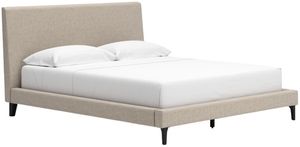
An upholstered headboard changes how a bedroom feels the moment you walk in, softening a room that otherwise runs to hard surfaces and wood tones. The Cielden does that in a soft gray that reads calm and coordinates with nearly any bedding, which matters more in this size because California king sheet sets come in fewer colors. The padded headboard also makes sitting up to read genuinely comfortable, with no hard edge behind your shoulders. A strong fit for a contemporary or transitional primary bedroom.
Top Features
- Upholstered panel headboard: Padded and comfortable for reading or watching TV in bed, with no hard surface behind you.
- Soft gray finish: A neutral that works with the narrower range of California king bedding colors available.
- California king sizing: Built for the 72 by 84 inch mattress, so your bedding and frame actually line up.
- Contemporary panel design: Clean lines that suit a modern or transitional bedroom without dominating it.
Signature Design by Ashley® Whittgate Beige California King Upholstered Panel Bed
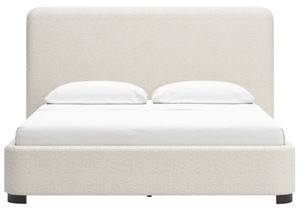
Beige upholstery warms a bedroom in a way gray does not, which is worth real consideration in a climate where the room gets its light from a gray sky for several months a year. The Whittgate delivers the same comfortable padded headboard in a warmer neutral, pairing naturally with oak, maple, and hickory woodwork common in central Wisconsin homes. Like any upholstered bed, it benefits from a headboard that can be vacuumed with a brush attachment now and then. A good choice for a room that should feel warm rather than cool.
Top Features
- Warm beige upholstery: Brings warmth to a bedroom that gets flat northern light much of the year.
- Padded panel headboard: Comfortable back support for sitting up, and quieter against the wall than wood.
- Coordinates with natural wood: Pairs easily with oak, maple, and hickory trim and furniture.
- True California king dimensions: Sized for the 72 by 84 inch mattress rather than adapted from another size.
Ashley® Maloken Mustard California King Upholstered Bed
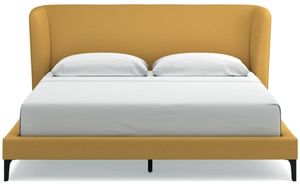
For a bedroom that should have some personality, the Maloken is the piece that provides it. Mustard upholstery is a genuine color choice rather than another neutral, and in a large primary bedroom a bed this size can carry it without overwhelming the room. It works especially well against white or soft gray walls, where the warmth of the fabric becomes the focal point and the rest of the room can stay quiet. Consider a fabric protection plan if pets share the bed.
Top Features
- Mustard upholstered finish: A deliberate color statement rather than a neutral, ideal as a room’s focal point.
- Upholstered headboard comfort: Soft support behind the shoulders for reading and lounging.
- Scaled for a large room: A California king footprint that anchors a spacious primary bedroom.
- Pairs with neutral walls: Reads best against white, cream, or light gray, letting the bed lead the room.
aspenhome® Cambridge Classic Cherry California King Panel Bed
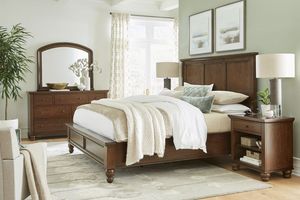
Cherry is the traditional bedroom wood, and the Cambridge collection uses it the way it should be used, with a warm classic finish and clean panel construction that will look correct in twenty years. This is the choice for a shopper who wants their bedroom to feel finished rather than trendy, and it pairs naturally with the woodwork in older central Wisconsin homes. A solid wood bed in this size is heavy and substantial, so plan the delivery path carefully and let our crew handle the assembly upstairs.
Top Features
- Classic cherry finish: A warm traditional wood tone that coordinates with existing millwork and case goods.
- Panel bed construction: Clean, timeless lines that avoid dating the room to a particular decade.
- Cambridge collection coordination: Part of a design family, so nightstands and dressers can match.
- Substantial build: Weight and construction consistent with a bed meant to last decades.
aspenhome® Cambridge Classic Cherry California King Panel Storage Bed
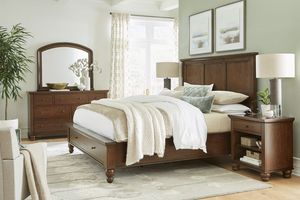
A bed this size covers a lot of floor, and this version puts that footprint to work. Built-in storage under the bed frame turns forty-two square feet of dead space into drawers, which is genuinely useful in older homes where closets were built small and bedroom storage is scarce. That makes it a practical answer for extra bedding, off-season clothing, or the heavy winter layers that only come out for four months. Storage beds also sit slightly higher than standard panel beds, which many people find easier to get in and out of.
Top Features
- Under-bed storage drawers: Converts unused floor space into usable storage, valuable in homes with small closets.
- Classic cherry panel styling: The same traditional finish and lines as the standard Cambridge panel bed.
- Higher deck height: Storage construction raises the bed slightly, which eases getting in and out.
- Seasonal storage capacity: Room for winter bedding and off-season clothing without adding another dresser.
aspenhome® Cambridge Classic Cherry California King Sleigh Bed
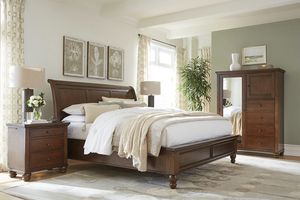
The sleigh silhouette is the more formal statement in the Cambridge line, with curved headboard and footboard shaping that gives a large bedroom a genuine focal point. In a California king it reads impressive rather than heavy, provided the room is large enough to give it air on both sides. Worth measuring twice for: a sleigh footboard extends beyond the mattress length, so add several inches to your 84-inch dimension when you tape out the footprint. Best in a spacious primary bedroom with traditional furnishings.
Top Features
- Curved sleigh design: A formal, traditional silhouette that anchors a large primary bedroom.
- Classic cherry finish: Warm wood tone consistent across the Cambridge collection.
- Footboard presence: Shaped footboard that finishes the bed visually from every angle in the room.
- Coordinating collection pieces: Matching case goods available so the room reads as a set.
aspenhome® Cambridge Classic Cherry California King Sleigh Storage Bed
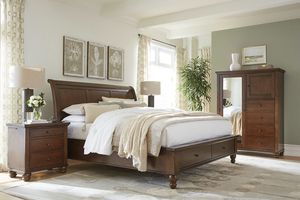
This is the fully loaded version of the Cambridge bed, combining the formal sleigh silhouette with under-bed storage drawers. For a large traditional bedroom where closet space is limited, it delivers both the look and the function without adding another piece of furniture to the floor. It is also the heaviest and most substantial bed in this group, so the delivery path and the assembly plan both matter. Our crews handle in-home setup and can advise on stair turns before your delivery date is set.
Top Features
- Sleigh styling with storage: Formal curved design combined with practical under-bed drawers.
- Classic cherry construction: Traditional wood tone and finish matched to the full Cambridge collection.
- Maximum storage capacity: The most functional bed here for a bedroom with limited closet space.
- Professional delivery and setup: Substantial enough that in-home assembly by our crew is the right call.
Find the California King Mattress That Fits Your Sleep and Your Space
This size is defined by extra length rather than extra width, so it solves a specific problem for tall sleepers and asks couples to give up two inches of personal width each. Your room and your delivery path have to accommodate 84 inches, and the construction and firmness you choose determine whether the bed actually sleeps well once it is in place.
Come stretch out on one. Shop mattresses and bedroom furniture online at Furniture & ApplianceMart or visit a showroom in the Wausau, Stevens Point, Wisconsin Rapids, Marshfield, or Appleton area and lie down in your own sleep position for as long as it takes. Our sleep specialists can match firmness to your position and body type, guide you to the right foundation or adjustable base in the correct size, and flag delivery path issues before they become delivery day problems. Our own crews handle setup and take the old mattress away, and our service support stays local years after the sale. Stop in or reach out with your bedroom measurements and we will work through it together.
Read more:
Beautyrest Mattress Buying Guide: Which Model Is Right for You?
Who Is a Purple Mattress Best For?
Frequently Asked Questions about California King Mattress Sizes
A california king mattress measures approximately 72 inches wide by 84 inches long, or about 6 feet by 7 feet. That works out to roughly 6,048 square inches of sleeping surface, and the 84-inch length is the longest of any standard mattress size sold in the United States.
No, a California king is longer but narrower than a standard king, which measures about 76 by 80 inches, and the two sizes have nearly identical total surface area. The California king trades four inches of width for four inches of length, so it is the better choice for tall sleepers and the standard king is the better choice for couples who want more side-to-side room.
A bedroom of about 12 by 12 feet is the practical minimum, since that allows roughly 24 inches of walking clearance on each open side of the bed. A room of 12 by 14 feet or larger is where the space stops feeling tight once nightstands, a dresser, and door swings are accounted for.
No, standard king sheets do not fit a California king mattress because they are four inches too wide and four inches too short. Fitted sheets in the wrong size will pull off the corners at the foot of the bed, so buy sheets, protectors, and comforters labeled specifically for a California king.
For sleepers around six feet and taller, the extra four inches of length is worth it because it solves cold feet, comforter tug-of-war, and the disrupted sleep that comes from heels hanging off the mattress. For sleepers under six feet, the added cost of the mattress, frame, foundation, and specialty bedding usually buys comfort a standard king would provide for less.
A California king needs a frame or foundation built specifically for the 72 by 84 inch footprint, with center support legs running to the floor to prevent sagging across the span. Foam and hybrid mattresses generally require slats spaced no more than about three inches apart or a solid platform, and using the wrong support base can void the mattress warranty.
Why Trust Furniture & ApplianceMart?
For over 55 years, Furniture & ApplianceMart has proudly served Wisconsin and Illinois as a local, employee-owned retailer built on family values and long-term relationships. What began as a customer-first business has grown into the area’s only true one-stop shop for furniture, appliances, and mattresses.
Our mission is to improve the quality of people’s lives by making amazing rooms together. We offer trusted national brands, competitive pricing, and flexible financing options for every budget to make furnishing your home simple and stress-free. We service what we sell with repairs completed by skilled, in-house technicians you can rely on. With a meet or beat price guarantee and a commitment to exceptional service after the sale, we stand behind every purchase.
Shop at Furniture & ApplianceMart
At Furniture & ApplianceMart, you’ll find a wide selection of furniture at competitive prices. From custom furniture to top-brand mattresses and major appliances, we make it easy to shop for everything you need in one store. Ask about clearance and scratch-and-dent savings available at every location, professional delivery and installation, design consultations, appliance repair services, and convenient financing options. Visit one of our showrooms across Wisconsin and Illinois or shop online today.