

The new queen memory foam mattress arrives on a Thursday, and by the following spring there are two shallow troughs pressed across it in a pattern that looks like a waffle iron left it there. The mattress is not defective. The slats holding it up sit five inches apart on a frame that got picked for its headboard, and foam sinks into every gap it is given. That is the quiet risk in a bed frame purchase, because the frame looks like the easy half of the decision. Choose wrong and you can void a mattress warranty, flatten a brand-new hybrid, or discover at the top of the stairs that a tall headboard will not turn the corner into the bedroom.
Find a Bed That Fits Your Room, Your Mattress, and Your Stairs
Our team matches beds to real room measurements and real mattresses, then handles delivery, assembly, and setup across central Wisconsin. Shop complete bedroom sets in one place, with financing available.
Explore bed frameThe reassuring part is that every one of those failures traces back to a short list of questions, and the answers are not complicated once somebody lays them out. At Furniture & ApplianceMart, we walk shoppers through this list every week in our central Wisconsin showrooms. This guide covers what a frame actually does, how to size one for your mattress and your room, platform versus traditional support and whether you need a box spring, slat spacing and center legs, materials and construction quality, headboard styles and storage options, adjustable base compatibility, and exactly what to confirm about delivery and setup before you hand over a deposit.
Key Takeaways
- The mattress decides the frame, not the reverse: Most mattress warranties spell out the support they require, including maximum slat gap and center leg count, so read that language before you shop.
- Slat spacing is the number that matters most: Foam and latex generally want gaps of about 3 inches or less, while an innerspring set on a box spring is far more forgiving.
- Queen and larger needs center support to the floor: A center rail with legs that reach the floor prevents the sag line down the middle of the bed and keeps warranty coverage intact.
- The exterior footprint is always bigger than the mattress: Rails, posts, and headboard depth add inches, so measure the doorway, the stair landing, and the wall before you buy.
What Does a Bed Frame Actually Do, and Do You Need One
A bed frame lifts the mattress off the floor, spreads weight evenly across the sleep surface, anchors the headboard and footboard, and lets air move underneath. Skip it and the mattress does all of that work alone, which it was never built to do.
The vocabulary trips people up because sellers use these terms loosely. Here is what each piece actually does.
- Bed frame: the structure that holds everything, usually rails plus some form of deck, headboard, and footboard.
- Bed rails: the side and end pieces that connect the headboard to the footboard and carry the slats.
- Platform bed: a frame with built-in slat or solid deck support, designed to hold a mattress directly.
- Foundation: a rigid, flat, wood-framed support box that sits inside or on top of a frame.
- Box spring: a support component with some give in it, meant to pair with innerspring mattresses.
- Bunkie board: a thin, solid support panel that adds a firm deck without adding much height.
- Adjustable base: a motorized foundation that raises the head and foot, and needs open space inside the rails.
The most common point of confusion is worth stating plainly. A box spring is a support component, not a frame, and it cannot hold a mattress by itself. A modern platform bed usually replaces the box spring entirely, which is why stacking both together almost always ends badly.
What Happens With No Frame at All
Putting a mattress on the floor seems thrifty until the underside stops breathing. Moisture from the room and from sleepers gets trapped against a cool floor, and mildew shows up on the bottom panel within a season or two. Dust and allergens collect faster at floor level too.
Getting in and out is harder on knees and backs, and it only gets harder over time. The bigger issue is paperwork. Plenty of mattress warranties list an acceptable support type, and floor use is frequently excluded outright.
Confirm What Actually Comes in the Box
Bed anatomy varies more than shoppers expect. Some listings include rails only. Some include a headboard and rails but no footboard. Some are complete beds with slats and center support included, and some sell the slat kit separately.
Ask before you order which pieces ship, whether slats and center legs are in the carton, and whether a foundation is needed on top of all that. Two beds at the same advertised price can be very different purchases once the missing parts are added.
Read more:
- Beautyrest Mattress Buying Guide: Which Model Is Right for You?
- Comparing Hybrid Mattress vs Memory Foam: Which is Better?
What Size Bed Frame Do You Need for Your Mattress and Your Room
Match the frame to the mattress size you own or plan to buy, then check that the room can hold the frame’s exterior footprint plus walking space. Those are two different measurements, and competitors gloss over the gap between them.
The mattress size sets the interior rail dimensions. The exterior footprint is always larger, because rails, corner posts, and headboard depth add inches on every side. A queen bed can easily measure 65 to 68 inches wide on the outside and 85 to 90 inches long once a chunky headboard and a footboard are counted.
Standard mattress sizes run about like this, and these are typical figures worth confirming against your own mattress tag:
- Twin: 38 by 75 inches.
- Twin XL: 38 by 80 inches.
- Full: 54 by 75 inches.
- Queen: 60 by 80 inches.
- King: 76 by 80 inches.
- California king: 72 by 84 inches.
Note that last pair. A California king is four inches narrower and four inches longer than a standard king, so the two frames are not interchangeable and neither are the sheets.
Room Size Guidance by Bed Size
Leave roughly two to three feet of walking clearance along both sides and the foot of the bed, then add room for nightstands and for dresser drawers or closet doors to swing open. Working backward from that, a twin fits comfortably in about 7 by 10 feet, a full wants roughly 10 by 11, a queen is happiest at 10 by 12 or larger, and either king size really needs about 12 by 12 feet before the room stops feeling like a maze.
Tape the full exterior footprint on the floor with painter’s tape before you commit, including the headboard depth and any footboard. Live with it for a day and open every drawer and door in the room. A taped rectangle that annoys you on a Tuesday will annoy you for the next fifteen years.
Ceiling height deserves a look too. Tall panel headboards, four-poster frames, and canopy beds need visual breathing room above them, and a bunk bed needs real measured clearance between the top mattress and the ceiling.
Measure the Delivery Path, Not Just the Room
This is where older homes around Wausau, Stevens Point, and Marshfield cause trouble. Farmhouses and early-century two-stories in this part of the state were built with narrow staircases, tight landings, and doorways that measure closer to 28 inches than 32.
Before you buy, measure the front doorway width, every hallway turn, the stairwell width, the landing where the stairs pivot, and the bedroom door itself. Also check basement ceiling height if the bed is headed downstairs. A one-piece upholstered headboard is the part that usually gets stuck, since it cannot be angled the way a knock-down rail can.
Finally, think about total sleep height. A 14-inch pillow top on a tall traditional frame can put the mattress surface above 30 inches, which is a genuine climb for shorter adults and for anyone with hip or knee issues.
Platform Bed Frame or Traditional Frame With a Box Spring
You need a box spring only if your mattress warranty calls for one or your frame is built to hold one. A platform bed with proper slat or deck support does not need a box spring, and adding one on top is almost always the wrong move.
Platform beds carry the mattress on a built-in deck, either closely spaced slats or a solid panel. That built-in support is why they suit memory foam, latex, and hybrid mattresses so well, and why they sit lower overall. Fewer components also means fewer things to squeak.
Traditional rail frames are the other approach. They are built to carry a box spring or a flat foundation, which then carries the mattress. The result is a taller sleep height that many shoppers prefer, and it remains the right answer for plenty of innerspring sets.
There is a middle path worth knowing about. A low-profile foundation, usually around 5 inches instead of 9, keeps a traditional frame’s structure while cutting total height. A bunkie board does something similar, adding a firm flat deck under foam without adding much height at all.
Two mistakes show up constantly. Stacking a box spring on a platform bed raises the mattress so far that the headboard looks stubby and the bed becomes hard to climb into. Pulling out needed support to lower a bed is worse, since foam left over wide gaps takes on permanent impressions.
The checkpoint that settles all of it is simple. Your mattress manufacturer’s warranty defines acceptable support, and that document outranks any sales pitch. Choose the frame to satisfy the mattress, not the other way around.
Bed Frame Types Compared Side by Side
Find the row that matches how you live and read across. Every figure below is a typical range across collections rather than a promise, so confirm the exact specifications on the product page and against your mattress documentation before you buy.
| Bed Frame Type | Best For | Box Spring Needed | Typical Sleep Height | Storage Potential | Assembly Effort | Relative Price Range |
|---|---|---|---|---|---|---|
| Platform Bed | Foam and hybrid mattresses | No | 16 to 22 inches | Low to moderate | Moderate | Budget to mid |
| Slatted Wood Bed | All-purpose bedrooms | No | 18 to 24 inches | Low | Moderate | Budget to mid |
| Metal Rail Frame | Guest rooms and tight budgets | Usually yes | 20 to 28 inches | Open underneath | Light | Budget |
| Upholstered Bed | Reading and lounging in bed | Sometimes | 20 to 28 inches | Low | Moderate to heavy | Mid to high |
| Storage or Captain’s Bed | Small rooms without closets | No | 18 to 26 inches | High | Heavy | Mid to high |
| Sleigh Bed | Traditional primary bedrooms | Often yes | 22 to 30 inches | Low | Heavy | Mid to high |
| Four-Poster or Canopy Bed | Large rooms with tall ceilings | Varies | 22 to 30 inches | Low | Heavy | High |
| Adjustable Base Compatible Bed | Future mattress upgrades | No | Varies by base | None | Moderate | Mid to high |
| Bunk or Trundle Bed | Kids, siblings, and guest rooms | No | Varies by tier | Moderate | Heavy | Budget to mid |
Use this second table when you are matching a mattress to a support style. Treat the spacing figures as typical guidance and verify them against your own mattress warranty.
| Mattress Type | Maximum Recommended Slat Gap | Center Support Required | Best Frame Match |
|---|---|---|---|
| Memory foam | About 2.75 to 3 inches | Yes on queen and larger | Platform or closely slatted bed |
| Latex | About 3 inches | Yes on queen and larger | Solid deck or bunkie board |
| Hybrid | About 3 to 4 inches | Yes on queen and larger | Platform with steel center rail |
| Innerspring on a box spring | Foundation carries the load | Yes under the foundation | Traditional rail or sleigh frame |
Read the first table top to bottom and the winners sort themselves out quickly. Storage beds and captain’s beds take the storage category outright, while sleigh, canopy, and upholstered styles carry the most visual weight in a room. Metal rail frames win on price and on assembly time, which is why they keep showing up in guest rooms and first apartments.
How Is the Bed Frame Supported Underneath
The support system under the mattress matters more than the style you can see, because it decides sag, noise, and whether a warranty claim gets paid. A gorgeous headboard on a weak deck is a bed you will replace in four years.
Slat spacing is the single most important specification on the page. Memory foam and latex generally need gaps of about 3 inches or less, hybrids can usually tolerate 3 to 4 inches, and an innerspring mattress riding on a proper foundation is the most forgiving of all. Wide gaps let foam settle into each opening, and those depressions become permanent because foam has no springs to push back.
Slat Types and What Each One Trades Away
- Solid wood slats: rigid, quiet, and long-lived, though they add weight and cost more than engineered stock.
- Sprung or curved slats: flexed beechwood that adds a little give and comfort, at the price of a shorter service life under heavy loads.
- Laminated engineered wood slats: the common mid-range choice, affordable and consistent, but more prone to bowing over time.
- Metal slats: very strong and thin, usually found in steel platform frames, though they can rattle if the brackets loosen.
Center Support Is Not Optional
Queen, king, and California king frames need a center rail with support legs that reach all the way to the floor. Two people rolling toward the middle of an unsupported queen put every pound of that load on side rails that were never designed to carry it.
Missing legs, or too few of them, is one of the leading causes of mattress sag and denied warranty claims. Many manufacturers expect at least one center leg on a queen and two or more on a king. Count them in the carton, not in the photo.
Weight capacity is worth asking about honestly. A published rating has to cover the mattress, both sleepers, and bedding all at once, and a heavy hybrid can weigh well over a hundred pounds by itself. Heavier sleepers should look toward welded steel or solid hardwood with extra center legs rather than lightweight bolt-together tubing.
Warning Signs You Bought Too Little Frame
- Creaking that shows up within the first few months instead of years.
- Slats sliding out of their brackets or ending up on the floor.
- A visible dip running down the center line of the mattress.
- Bolts that loosen again a week after you tighten them.
Most of these are fixable at purchase rather than after. Ask whether a slat conversion kit, a bunkie board, additional center legs, or a closer-spaced slat set is available for the frame you are considering. Adding forty dollars of support at checkout is cheaper than replacing a mattress.
Which Bed Frame Material Holds Up Best
There is no single winner here, only a trade among durability, style, noise, upkeep, and price. The material that fits a college apartment is rarely the one that fits a primary suite you plan to keep for twenty years.
Solid Wood
Kiln-dried hardwoods such as oak, maple, cherry, and acacia are the long-haul choice. They resist dents, hold hardware tightly, and can be refinished decades later. Pine is real wood too, but it is soft enough to mark from a dropped phone.
Watch for the difference between solid wood and veneer over engineered panels, MDF, or particleboard. Veneered pieces can look beautiful and cost far less, though they cannot be sanded back and they suffer badly if water sits on them. Joinery, panel thickness, and hardware quality predict lifespan better than the finish does.
Metal
Heavy-gauge welded steel is a different product from lightweight bolt-together tubing, even when both are painted the same black. Welded joints and thicker tubing are what keep a metal bed quiet, because most squeaks come from metal-on-metal movement at bolted connections.
Nylon washers between joints, locking hardware, and a good powder-coated finish all help. Powder coat matters most in humid rooms and basements, where a thin painted finish will eventually chip and rust at the contact points.
Upholstered
Fabric choice drives everything about how an upholstered bed ages. Performance polyester resists stains and cleans easily, chenille is soft and hides wear, velvet looks rich but shows crushing, and faux or top-grain leather wipes clean in seconds.
Look at padding depth if you read or watch television in bed, and look at the cleaning code before you commit in a house with kids or pets. Tufted styles look tailored but collect crumbs in the buttons, while a smooth panel wipes down in one pass.
Here is the maintenance detail our delivery team flags on every bed we set up: retighten the rail-to-headboard and center-leg bolts about 30 days after delivery, then once each fall when the furnace comes on. Wisconsin homes swing from humid August air to single-digit indoor humidity in January, wood shrinks slightly, bolts back off, and a small wobble turns into an oval bolt hole. Many furniture warranties specifically exclude damage caused by loose hardware, so ten minutes with a hex key protects your coverage.
Match the Material to the Room
- Guest room used a dozen nights a year: a metal rail frame or a simple slatted wood bed.
- Growing child’s room: solid wood or steel that survives climbing and repeated moves.
- Primary suite you intend to keep: kiln-dried hardwood or a well-built upholstered bed.
- Rental or first apartment: lightweight metal or a knock-down platform that reassembles easily.
Frame quality is far easier to feel than to read on a spec sheet. Our showroom staff can walk you through the construction differences between two beds standing side by side, which is a two-minute conversation that saves a lot of second-guessing.
Platform Bed Frame Pros and Cons Before You Buy
Platform styles now make up the majority of what shoppers see, largely because foam and hybrid mattresses took over the mattress category and those mattresses want flat, close support. That popularity is earned, but it comes with honest trade-offs against a traditional frame and box spring.
Pros
No box spring to buy:
The deck is built in, which removes a component that often costs a couple hundred dollars and adds bulk to the delivery.
Even support that protects foam:
Closely spaced slats or a solid deck keep memory foam and hybrids from settling into gaps, which is the failure mode that causes most sag complaints.
A cleaner, lower profile:
Lower height suits modern rooms and makes a small bedroom feel less crowded, since the bed does not dominate the sightline.
Storage is often available:
Many platform designs offer under-bed drawers or open clearance for bins, which matters in older homes with shallow closets.
Cons
Lower sleep height:
Getting in and out of a bed that sits closer to the floor is harder for older adults and for anyone with knee or hip limitations.
Older innerspring mattresses can feel firmer:
A mattress that spent years on a flexible box spring will feel noticeably stiffer on a rigid deck, and that adjustment surprises people.
Read more:
What Headboard Style and Bed Height Should You Choose
Choose the headboard that matches how you use the bed, then confirm the height works with your room and your nightstands. Style is the fun part, but each style carries a practical consequence.
Headboard Styles and What They Actually Do
- Panel: flat or framed wood panels, the versatile default that suits nearly every room.
- Upholstered and tufted: padded and comfortable to lean against, best for readers and television watchers.
- Wingback: upholstered with side wings that block drafts and create a cocooned feel in a large room.
- Slat: horizontal or vertical open slats that keep sightlines light in a small bedroom.
- Bookcase: built-in shelving that replaces a nightstand when floor space is short.
- Sleigh: curved and substantial, a traditional look that needs a room large enough to carry it.
- Four-poster and canopy: dramatic and tall, requiring both ceiling height and visual space around the bed.
- Headboard-only: attaches to a metal frame or mounts to the wall, the flexible option for renters.
Footboards deserve the same thought. A full footboard finishes the look but shortens the usable interior, which matters for anyone over six feet tall. Low-profile and open-foot designs give tall sleepers room to stretch and make a small bedroom feel longer.
Storage Beds, Drawers, and Clearance
Storage beds are underrated in this part of the state, where older bedrooms often have one shallow closet and no built-ins. Under-bed drawers handle off-season clothing well. Captain’s beds go further with a full bank of drawers on one or both sides. Lift-up hydraulic platforms open the entire under-bed cavity for bedding and luggage.
Each style asks something of the room. Side drawers need roughly 20 to 24 inches of pull-out clearance on whichever side they open, so confirm which side that is before delivery day. A lift-up platform needs no side clearance but does need the bed pulled away from the wall enough for the deck to swing. Drawers also carry weight limits, and most storage beds cannot accept an adjustable base at all.
Bed height is the last piece. Aim for a mattress top that lands within a couple inches of your nightstand surface, since a nightstand six inches below the mattress is hard to reach for a glass of water. A sleep surface between 24 and 27 inches suits most adults for easy entry and exit, while children and older adults are usually better served closer to 20 to 24 inches.
One detail to check on any headboard you like: whether it is drilled for standard bolt-on rails. A headboard with universal bolt patterns can later pair with a different frame or with an adjustable base, which keeps your options open if the mattress changes before the bedroom does.
Will This Bed Frame Work With an Adjustable Base
An adjustable base fits inside a frame only when the frame has an open interior with nothing in the way. The base needs no fixed deck, no permanent slats, and no center support blocking the space, plus enough interior depth for the base to bend without hitting the rails.
Two approaches work in practice. The first is a frame sold as adjustable base compatible, engineered from the start with an open interior. The second is a traditional rail frame with removable slats, where you pull the slat set out and let the base stand on its own legs inside the rails.
Measure these before you buy, and write the numbers down:
- Interior rail length and width, which must exceed the base dimensions.
- Rail height from the floor, so the base legs can be set to match.
- Clearance above the side rails, since the base sits higher than a plain slat deck.
- Whether the headboard bolts to the frame or can be mounted to the base itself.
Some beds simply will not work, and it is better to hear that now. Most solid-deck platform beds, nearly all storage and captain’s beds, and any frame with permanently fixed center supports are out unless the manufacturer specifically says otherwise.
A few details catch even careful shoppers. When the head section raises, the mattress slides forward and opens a gap at the headboard unless a retainer bar holds it. Power cords need a route to an outlet that does not run under a leg. Split king setups need two bases inside one frame, and the frame’s interior width has to accommodate both without pinching.
This question matters even if an adjustable base is not in the plan this year. Buying a frame with an open interior protects the investment if a future mattress upgrade or a medical need points toward one later. Furniture & ApplianceMart carries mattresses and adjustable bases alongside bedroom furniture, so compatibility can be confirmed in a single showroom visit instead of over three phone calls.
What to Ask About Price, Delivery, and Assembly Before You Buy
Price bands track construction more than brand. Entry-level frames use lighter engineered panels or thin bolt-together tubing and generally run a few hundred dollars. Mid-range beds bring solid wood components, better hardware, and real center support. Heirloom-quality beds use kiln-dried hardwood, mortise-and-tenon or dowel joinery, and finishes that can be repaired, and they cost accordingly.
Compare Quotes on the Same Basis
Two prices are only comparable when they cover the same parts. Before you decide, confirm each of these:
- Whether the price is rails only, headboard and rails, or the complete bed.
- Whether slats and center legs are included or sold separately.
- Whether a foundation or box spring is required and whether it is extra.
- Whether the quoted size matches your mattress exactly, especially between king and California king.
Delivery and Setup Questions
- Is assembly included, or is the bed delivered in cartons?
- Will the crew carry the bed upstairs and around the landing?
- Can the old bed and mattress be hauled away the same day?
- What is the lead time on special-order sizes and finishes?
- What happens if a rail or panel arrives damaged, and how fast are replacement parts?
Warranty and Service Questions
Ask how long the frame warranty runs and what it covers, since structural coverage and finish coverage are often different terms. Ask whether replacement hardware and slats can be ordered years later. Confirm the return and restocking policy before delivery, and ask whether a protection plan covers upholstered fabric against stains and tears, which is worth real money in a house with kids.
Bring This List to the Showroom
- Room dimensions and a rough floor-plan sketch showing windows, doors, and vents.
- Doorway, hallway, and stairwell measurements, including the landing.
- Current mattress size, thickness, and brand.
- Nightstand height and dresser dimensions.
- Photos of your existing bedroom finishes for wood-tone and fabric matching.
A Decision Path by Scenario
- First apartment or guest room on a tight budget: a metal rail frame or simple platform bed.
- Primary bedroom upgrade with a new foam or hybrid mattress: a platform bed with close slat spacing and steel center support.
- Small bedroom short on closet space: a storage bed or captain’s bed, with drawer clearance measured first.
- Child’s room that has to grow with the child: solid wood or steel in a twin or full, chosen for durability over trend.
- Couple planning an adjustable base: an open-interior frame with removable slats and a headboard drilled for bolt-on rails.
Bring those measurements to a Furniture & ApplianceMart showroom and an associate can confirm fit, support, stock, and delivery timing in one visit. That beats ordering blind and finding out on delivery day.
The Landing Test: Whether Your Headboard Will Turn the Stairs
Most delivery problems in older central Wisconsin homes come down to one geometry problem that nobody measures. A rigid headboard has to pivot at the stair landing, and the space it needs is not its width, it is its diagonal. Take the headboard’s height and thickness, then picture it rotating flat through the turn: the corner-to-corner measurement is what has to clear both walls at once. A 60-inch tall headboard needs roughly 60 inches of open pivot space at the landing, and a stairwell that measures 34 inches wide with a wall directly across the landing simply will not give it. This is why an upholstered one-piece headboard gets stuck where a knock-down metal frame walks right up.
Run this check before you buy anything with a tall or one-piece headboard:
- Measure the stairwell width wall to wall, plus the handrail projection, which often steals 3 to 4 inches.
- Measure the landing depth and width where the stairs change direction.
- Measure the ceiling height above the landing, since the headboard has to tilt as it turns.
- Compare the headboard’s longest dimension to the smaller of the landing measurements, and expect trouble when they are within a few inches.
- Ask whether the headboard ships in two pieces or with a removable upholstered panel, because split construction solves most tight-stair situations.
- Confirm the delivery team can remove a bedroom door from its hinges if the last few inches are the problem.
Read more:
- What's Included in an Ashley Furniture Bedroom Set?
- Why Furniture & ApplianceMart Stands Out Among Furniture Stores in Milwaukee
Shop Bed Frames and Bedroom Sets at Furniture & ApplianceMart
The six beds below cover genuinely different answers to the questions above, from a padded headboard built for reading to a California king that demands a real primary suite. Each one is matched to a specific shopper and a specific room, so compare them against your measurements rather than against a photo. All are available with local delivery and professional setup across the Wausau, Stevens Point, Wisconsin Rapids, Marshfield, and Appleton areas, with financing available.
Signature Design by Ashley Cielden Soft Gray Queen Upholstered Panel Bed
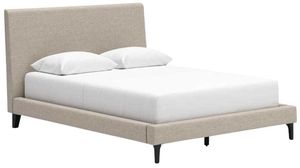
If you read or watch television in bed, a wooden headboard stops being charming after about a week. The Cielden answers the headboard comfort question with a padded upholstered panel you can actually lean against, in a soft gray that sits quietly beside existing wood dressers and painted walls. Queen sizing keeps the exterior footprint manageable in a standard bedroom. Follow the upholstery guidance covered earlier: vacuum the panel with a brush attachment and blot spills instead of scrubbing. A protection plan on the fabric is worth asking about in a house with kids or pets.
Top Features
- Padded upholstered headboard: Gives real back support for reading and screen time, which a flat wood panel never delivers.
- Soft gray neutral finish: Bridges warm and cool bedroom tones, so it works without replacing your existing dressers.
- Queen panel bed format: A familiar footprint that fits most primary and secondary bedrooms with room to walk.
- Fabric care is straightforward: Regular vacuuming and prompt blotting keep the panel looking new for years.
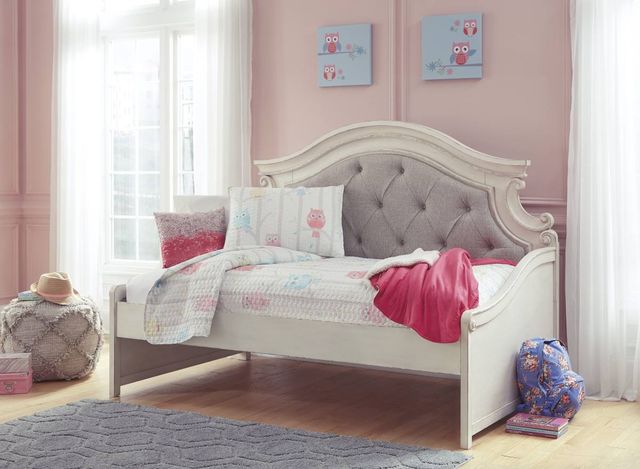
Signature Design by Ashley Realyn Chipped White Twin Day Bed
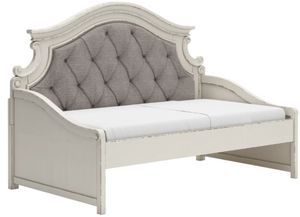
A spare room that has to be an office six days a week and a guest room on the seventh is exactly the problem a day bed solves. The Realyn works as seating against a wall during the day and a twin sleeping surface at night, so a 10 by 10 bedroom stops feeling like it is committed to one purpose. The chipped white cottage finish suits older Wisconsin homes with painted trim and wood floors. Twin sizing also means it moves up narrow staircases without the landing drama a full-size headboard creates.
Top Features
- Dual-purpose day bed design: Serves as a sofa-style seat by day and a twin bed at night in a room doing double duty.
- Chipped white cottage finish: Complements the painted woodwork common in older central Wisconsin houses.
- Twin footprint: Fits small bedrooms and moves easily through narrow doorways and tight stair landings.
- Three-sided support structure: Back and side panels frame the mattress and keep bedding from sliding off.
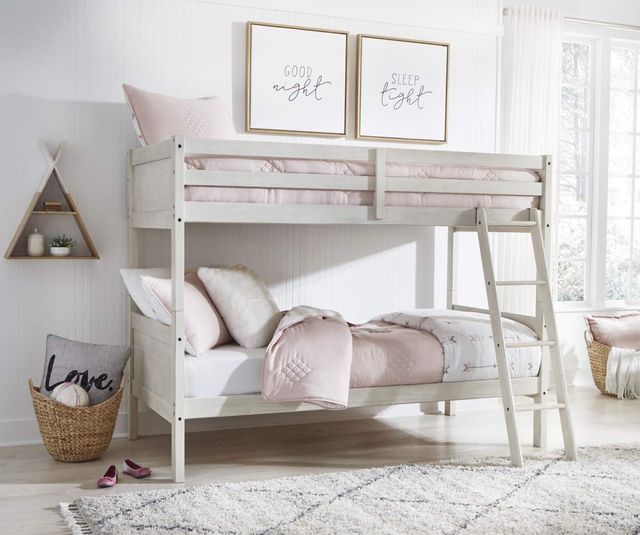
Signature Design by Ashley Robbinsdale Antique White Youth Twin/Twin Bunk Bed with Ladder
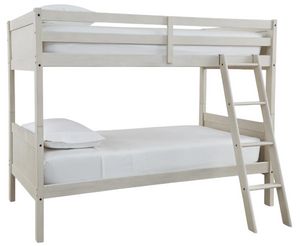
Two kids in one bedroom is the classic case for a bunk bed, and the ceiling height question from earlier applies directly here. Measure from the floor to the ceiling before ordering, then confirm there is comfortable sitting room above the top mattress once the mattress thickness is added. The Robbinsdale pairs twin over twin with an included ladder and an antique white finish that works past the toddler years. Use a low-profile mattress on top so the guard rails keep their intended height, and check the manufacturer’s mattress thickness recommendation.
Top Features
- Twin over twin configuration: Sleeps two children in the floor space of one bed, which frees up room for desks and play.
- Included ladder: Provides a fixed, intended climbing route rather than kids scaling the end rails.
- Antique white youth finish: Neutral enough to carry a child from early grades into the teen years.
- Ceiling clearance matters: Measure your room height and use a thinner top mattress to preserve guard rail coverage.
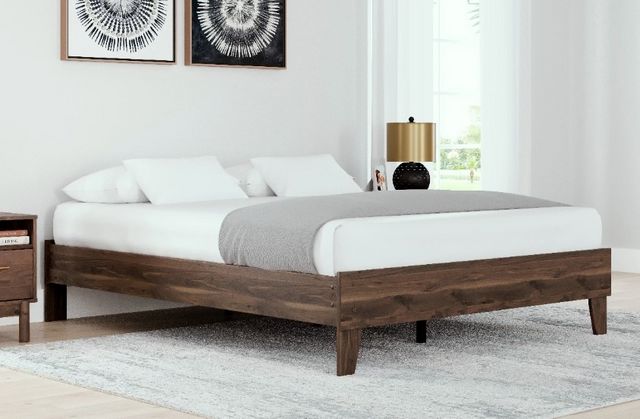
Signature Design by Ashley Calverson Mocha Queen Platform Bed
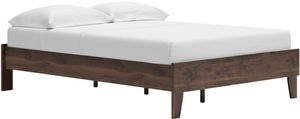
This is the direct answer to the box spring question. The Calverson is a queen platform bed, which means the support deck is built in and there is no separate box spring to buy, haul upstairs, or find room for. That makes it a natural partner for a memory foam or hybrid mattress, the combination that suffers most on a wide-gap frame. The mocha finish reads warm without going dark, and the lower platform profile keeps a modest bedroom feeling open. Confirm the slat spacing against your mattress warranty before delivery.
Top Features
- Built-in platform support: No box spring required, which removes a purchase and simplifies the delivery.
- Queen sizing: The most common bedroom size, with a footprint that suits rooms around 10 by 12 feet.
- Warm mocha finish: Coordinates with medium wood tones and luxury vinyl plank flooring without fighting them.
- Lower profile design: Keeps sightlines open in a smaller bedroom and suits contemporary rooms.
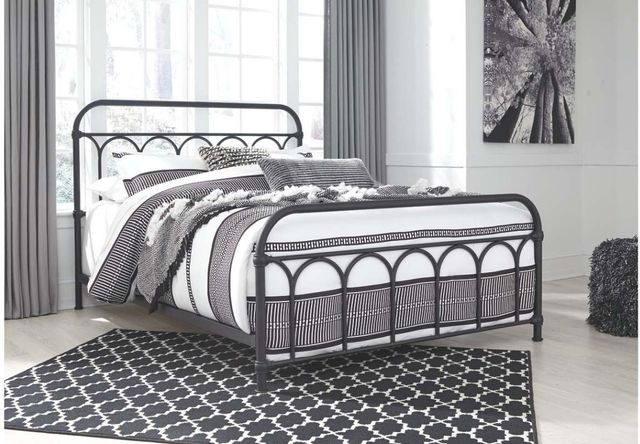
Signature Design by Ashley Nashburg Black Queen Metal Rod Bed
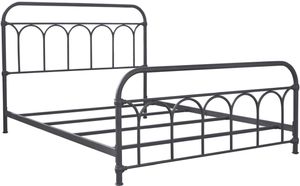
Metal beds are the value pick for guest rooms and first apartments, and the Nashburg brings a black rod-style headboard and footboard that looks intentional rather than temporary. Because metal rod beds are built around a rail system rather than a solid deck, this is the frame where the support conversation from earlier pays off. Ask about the slat or foundation setup and the center support before delivery, especially with a heavy hybrid mattress. Queen sizing plus a knock-down structure also makes this one of the easier beds to carry up an older staircase.
Top Features
- Black metal rod construction: Slim vertical rods keep a small guest room visually open compared with a solid panel.
- Queen size: Comfortable for two guests without demanding a large room.
- Rail-based support system: Confirm the slat kit, foundation, and center legs at purchase to match your mattress type.
- Easier to move upstairs: Knock-down metal components handle narrow stairwells and tight landings better than one-piece headboards.
Aspenhome Cambridge Classic Cherry California King Panel Bed
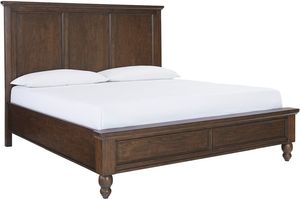
A California king is four inches narrower and four inches longer than a standard king, so this is the size for tall sleepers with a room big enough to carry it. Plan on roughly 12 by 12 feet of bedroom before walkways get tight, and run the landing test from the previous section before delivery day. The classic cherry finish and traditional panel styling suit a primary suite meant to stay put for decades. Confirm center support legs at purchase, since a bed this wide depends on them to prevent a center sag line.
Top Features
- California king sizing: Four inches longer than a standard king, which is the answer for sleepers over six feet tall.
- Classic cherry finish: A traditional tone that anchors a primary suite and coordinates with matching bedroom pieces.
- Panel bed styling: A substantial headboard presence that suits larger rooms with adequate wall space.
- Center support is essential: Confirm the center rail and legs are included, since wide beds sag without them.
- Measure the delivery path first: Large panel components need stairwell and landing clearance checked before order.
Ask the Right Bed Frame Questions and Sleep Better for Years
Correct sizing, proper slat spacing, real center support, honest construction, and future compatibility with a mattress or adjustable base matter far more than the lowest sticker price on a listing page. A frame that protects your mattress warranty and fits your room the first time costs less over ten years than two cheap ones. Get those answers before you buy and the rest of the decision becomes a matter of taste.
Shop beds and bedroom sets at Furniture & ApplianceMart online, or bring your measurements to one of our central Wisconsin showrooms and see the difference between two frames standing side by side. Our associates can explain construction differences you cannot read on a spec sheet, check mattress and adjustable base compatibility in the same visit, and arrange professional local delivery and setup instead of leaving cartons at the curb. Flexible financing is available, and when you need a replacement slat or a service call three years from now, you are calling neighbors in Wisconsin rather than a big-box call center. That is what buying from an independent local retailer gets you.
Frequently Asked Questions about Bed Frames
No, a platform bed frame has built-in slat or solid deck support, so a box spring is not needed and should not be added. Stacking one on top raises the mattress too high for the headboard and makes the bed harder to get into.
Slats under a memory foam mattress should generally sit no more than about 3 inches apart, and many manufacturers specify 2.75 inches. Wider gaps let the foam settle into each opening and create permanent depressions that warranty coverage usually excludes.
Yes, queen, king, and California king frames need a center rail with legs that reach the floor, typically one leg on a queen and two or more on a king. Without them the side rails carry a load they were not designed for, which causes sag down the middle and voids many mattress warranties.
A bed frame is the structure that holds the whole bed together, including rails, headboard, and footboard, while a foundation is a rigid support box that sits inside or on top of that frame. The frame provides structure and style, and the foundation provides the flat support surface a mattress rests on.
A well-built solid hardwood or welded steel bed frame commonly lasts 15 to 25 years, while lightweight engineered wood or bolt-together metal frames often show wear within 5 to 10 years. Joinery quality, hardware, and whether bolts get retightened periodically matter more to lifespan than the original price.
No, an adjustable base only works with frames that have an open interior and no fixed deck, permanent slats, or built-in center support in the way. Most solid-deck platform beds and storage or captain’s beds cannot accept one, while traditional rail frames with removable slats usually can.
Why Trust Furniture & ApplianceMart?
For over 55 years, Furniture & ApplianceMart has proudly served Wisconsin and Illinois as a local, employee-owned retailer built on family values and long-term relationships. What began as a customer-first business has grown into the area’s only true one-stop shop for furniture, appliances, and mattresses.
Our mission is to improve the quality of people’s lives by making amazing rooms together. We offer trusted national brands, competitive pricing, and flexible financing options for every budget to make furnishing your home simple and stress-free. We service what we sell with repairs completed by skilled, in-house technicians you can rely on. With a meet or beat price guarantee and a commitment to exceptional service after the sale, we stand behind every purchase.
Shop at Furniture & ApplianceMart
At Furniture & ApplianceMart, you’ll find a wide selection of furniture at competitive prices. From custom furniture to top-brand mattresses and major appliances, we make it easy to shop for everything you need in one store. Ask about clearance and scratch-and-dent savings available at every location, professional delivery and installation, design consultations, appliance repair services, and convenient financing options. Visit one of our showrooms across Wisconsin and Illinois or shop online today.