


Grocery day ends the same way in a lot of kitchens. The gallon of milk goes in sideways because it will not stand up under the shelf, the party platter from the deli counter gets balanced on top of the eggs, and the second bag of apples goes into the crisper that is already full, where it will turn soft by Thursday. Meanwhile the door swings out past the counter edge and stops the walkway cold every time someone opens it. A KitchenAid refrigerator is one answer to that daily friction, but only if the configuration, the depth, and the preservation features match the way your kitchen actually runs.
Find the Refrigerator That Fits Your Kitchen and Your Groceries
Our appliance team measures kitchens and matches configurations for central Wisconsin families every week, from galley kitchens to full remodels. Shop refrigerators, ranges, and complete kitchen suites with delivery, installation, water line hookup, and haul-away handled by our own crews.
The encouraging part is that every one of those problems has a specific fix, and none of them require guessing. At Furniture & ApplianceMart, our showrooms in the Wausau, Stevens Point, Wisconsin Rapids, Marshfield, and Appleton areas let you open the doors, pull the drawers, and hold a tape measure to the shelves before you decide, and our team will help you check your opening. This guide covers what sets the brand apart, the configurations available, counter-depth against standard-depth, how to measure, which features are worth paying for, how installation and care work, and the five KitchenAid refrigerators we most often put side by side on our floor.
Key Takeaways
- Configuration decides daily flow: French door, four-door, side by side, and bottom freezer layouts differ most in door swing and in whether a wide platter can lay flat, not in cubic feet.
- Depth is a trade you make on purpose: Counter-depth models sit nearly flush with cabinet fronts and give up interior capacity, while standard-depth models hold more and project into the walkway.
- Preservation features earn their keep: Dual evaporators, humidity-controlled crispers, and temperature-controlled pantry drawers directly change how long produce and proteins last.
- Measure the path, not just the opening: More refrigerator deliveries fail at a hallway turn or a stair landing than at the cabinet cutout itself.
What Makes a KitchenAid Refrigerator Different From Other Brands
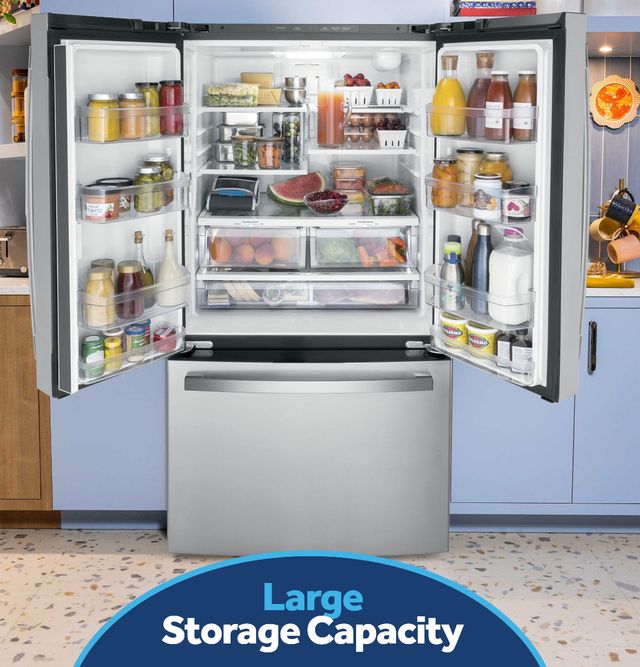
This brand sits in the premium tier, and the money goes into food preservation engineering, interior materials, and a design language built to coordinate with a full cooking suite. Buyers rarely purchase one of these in isolation. They buy it because the range, the dishwasher, and the wall oven are going to match.
The Preservation Technologies in Plain Language
- ExtendFresh Temperature Management System: Uses separate sensors and controls for the refrigerator and freezer sections so each holds its target temperature independently instead of trading air back and forth.
- Preserva Food Care System: Pairs a dedicated air filtration approach with a two-evaporator design so odors and moisture do not migrate between compartments.
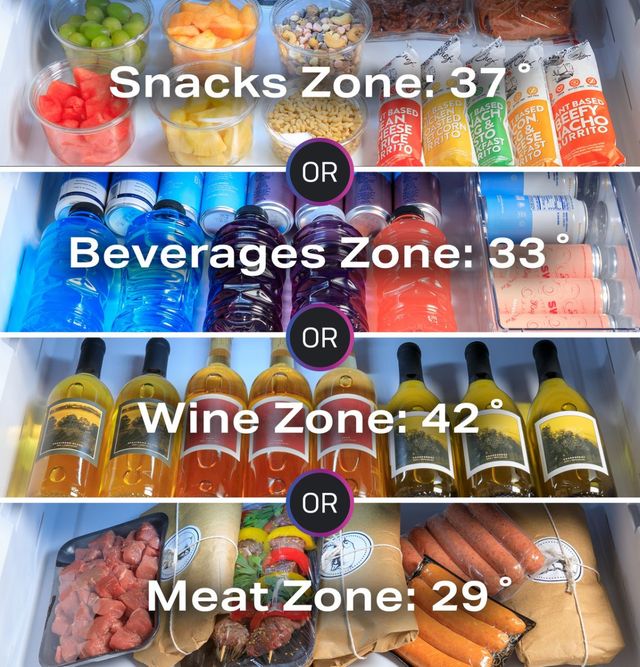
- FreshChill temperature-controlled pantry drawer: A full-width drawer with its own temperature setting, which is what finally gives a party platter, a sheet cake, or a marinating pan a flat home.
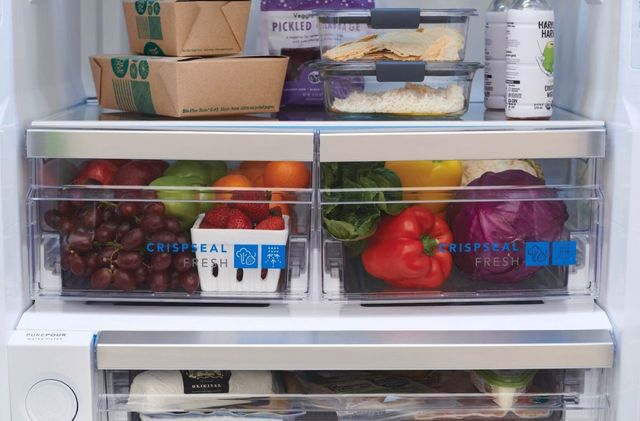
- FreshSeal humidity-controlled crisper bins: Sealed bins with adjustable humidity, so leafy greens stay in high humidity and apples and pears stay in low.
Why Dual Evaporators Actually Matter
Most feature lists mention dual evaporators and move on. Here is what the mechanism does. A single-evaporator refrigerator makes cold in one place, usually the freezer, then pushes some of that air into the fresh food compartment through a damper. That shared air carries freezer odor into your produce and pulls moisture out of the freezer, which is what freezer burn actually is. Two evaporators mean two separate cold circuits and no shared air path, so onions do not flavor the ice cream and a package of venison keeps its moisture through a long winter.
The materials story is visible the moment you open a door. The PrintShield finish resists fingerprints on a handle that gets touched forty times a day, which matters far more on a busy family refrigerator than it does in a showroom. Inside, platinum interiors with metallic accents, panoramic LED lighting, and soft-close drawers are the details that separate a premium cabinet from a mainstream one.
KitchenAid Refrigerator Configurations Explained
Configuration is the first real decision, and it has more to do with your floor plan than your grocery list.
Read more:
Counter Depth vs Standard Refrigerators: What's the Difference?
Exploring Different Types of Kitchen Vent Hoods
The Layouts and Their Trade-Offs
- French door with a freezer drawer: Two narrow doors up top mean a smaller swing arc, and the full-width fresh food compartment lets a platter lay flat. The freezer is a drawer you look down into.
- Four-door French door: Adds a middle zone that converts between refrigerator and freezer temperatures, which is the answer for households that alternate between hosting and batch-freezing.
- Side by side: Tall narrow doors need the least clearance to open, and frozen items sit at eye level instead of at the bottom. Nothing wide lays flat.
- Bottom freezer: The simplest layout, with a single full-width fresh food door and a freezer drawer below. A single wide door needs the most swing room.
- Built-in and panel-ready: Sits flush in cabinetry, often as a column or a full-size unit, and accepts custom door panels so the refrigerator disappears into the run of cabinets.
Built-in means the unit is designed to be surrounded by cabinetry with ventilation planned into the enclosure. Panel-ready means the doors accept a cabinet panel matched to the rest of the kitchen. Both require cabinetry coordination and professional installation, and neither is a decision to make after the countertops are in.
Width is the first constraint to confirm, always. Standard freestanding models cluster around thirty, thirty-three, and thirty-six inches, and built-in models run wider. A thirty-six inch cabinet opening does not accept a thirty-six inch refrigerator without checking the manufacturer’s required clearances first.
Matching a Layout to Your Household
- You entertain often: French door or four-door, because platters, sheet cakes, and deli trays need full-width flat space.
- You batch cook and freeze: Four-door with a convertible zone, or a bottom freezer with a large drawer, since freezer volume is your real constraint.
- A shorter household member needs freezer access daily: Side by side, because bending into a bottom drawer every day gets old fast.
- You have a galley kitchen: Side by side or French door, since a single wide door swinging into a narrow aisle blocks the whole room.
Counter-Depth Versus Standard-Depth: Which One Fits Your Kitchen

Counter-depth models run roughly twenty-four to thirty inches deep and sit nearly flush with the front of your cabinets. Standard-depth models run roughly thirty-five to thirty-six inches deep and project several inches past the counter, doors and handles adding more on top of that.
The trade is honest and unavoidable. You give up interior capacity to gain a flush line and a clearer walkway. A counter-depth model in a thirty-six inch width typically holds several cubic feet less than a standard-depth model of the same width, and it usually costs more per cubic foot, because the engineering to fit the same features into a shallower cabinet is harder.
Counter-depth also looks larger in a showroom than it lives at home. A showroom floor has no walls crowding it and no cabinets framing it. Judge usable capacity by shelf width and door bin depth instead of by the cubic foot number, because a cubic foot at the back of a deep shelf where nothing gets found is not storage, it is a place for leftovers to go bad.
Standard-depth is clearly the better answer when you have a large household, when you buy in bulk, or when your kitchen already has a deep alcove framed for a full-depth unit. There is no design benefit to a counter-depth model sitting in an opening built for something deeper.
Before you decide, run this test in your own kitchen. Put a strip of painter’s tape on the floor thirty inches out from the wall behind the refrigerator, then a second strip at thirty-six inches, then walk the path you use carrying a laundry basket. That six inches is the entire argument, and standing in it settles the question faster than any spec sheet.
How to Measure and Plan for a New Refrigerator
Take five measurements and a photo before you shop, and delivery day stops being suspenseful.
- 1. Opening width at the narrowest point, including any trim, and check whether it is square from top to bottom.
- 2. Opening height, and confirm hinge clearance so the doors can open fully without hitting an upper cabinet.
- 3. Depth from the back wall to the front of the cabinet face, then decide whether handles are allowed to project past it.
- 4. Door swing clearance to an adjacent wall or island, since a door that only opens ninety degrees will not let a crisper drawer slide out.
- 5. The delivery path: doorway widths, hallway turns, stair landings, and low ceilings.
Ventilation is not optional. Manufacturers publish required clearances at the top, sides, and rear, and crowding a refrigerator makes the compressor run longer and hotter, which costs efficiency now and compressor life later.
Utilities come next. Confirm the outlet location and whether the circuit is dedicated, and locate the water line if the model dispenses water or makes ice. If there is no water line at all, the fix is a plumbing run, and that is a conversation to have before you buy rather than while the crew is standing in your kitchen.
For built-in and panel-ready installations, the cabinetry cutout dimensions come from the manufacturer’s specification sheet, not from the old unit. Professional installation is required, and panel weight and hinge adjustment have to be set correctly or the doors will sag within the first year.
Bring this checklist to the showroom: opening width, height, and depth; door swing clearance; narrowest point of the delivery path; outlet and circuit; water line location; and a photo of the space with a tape measure in the frame.
KitchenAid Refrigerator Styles, Capacities, and Features Compared
Start with the configuration row that matches your floor plan, then read across for the practical consequences.
| Configuration | Typical Width | Typical Capacity | Standout Storage | Best-Fit Kitchen | Price Tier |
|---|---|---|---|---|---|
| French door, freezer drawer | 30 to 36 inches | About 20 to 31 cu. ft. | Full-width shelves for platters | Families and hosts | Mid to upper |
| Four-door French door | 36 inches | About 24 to 30 cu. ft. | FreshChill full-width refrigerated drawer | Batch cooks and entertainers | Upper |
| Side by side | 33 to 36 inches | About 20 to 29 cu. ft. | Eye-level freezer shelves | Galley and narrow kitchens | Mid |
| Bottom freezer | 30 to 36 inches | About 18 to 22 cu. ft. | Simple full-width fresh food | Smaller kitchens and condos | Entry to mid |
| Built-in or panel-ready | 36 inches and wider | About 20 to 30 cu. ft. | Flush cabinetry integration | Full remodels and custom kitchens | Premium |
Specifications and pricing vary by model and change with the season, so use this as a shortlist tool and let our appliance team confirm current availability and pricing on the exact model you want.
Key Features Worth Paying For and Ones You Can Skip
Features fall into four groups, and they are not equally worth your money.
Preservation Features: Usually Worth It
Dual evaporators, humidity-controlled crispers, temperature-controlled pantry drawers, and air and water filtration all change how long food lasts, which is the entire job of the appliance. If you cook from fresh ingredients more than a couple of nights a week, this is where the budget belongs.
Storage Flexibility: Worth It If You Have the Problem
Full-width pantry drawers solve the platter and sheet-cake problem. Slide-away split shelves solve the tall bottle problem. Adjustable and removable bins, pull-out trays, and beverage caddies solve smaller ones. Look at what currently sits sideways in your refrigerator and buy the feature that fixes that specific thing.
Water and Ice: Depends on the Household
Exterior dispensers are convenient and cost interior door space. Interior dispensers keep the door face clean and make you open the door. Ice production rates matter if you host; specialty ice is a genuine luxury. Budget for replacement water filters two or three times a year as an ongoing cost, not a one-time one.
Convenience and Connectivity: Mostly Skippable
Door alarms get used. Sabbath mode matters to the households that need it. Good interior lighting is worth more than people expect. App control and connected features get real use for the first month and occasional use after that, so let them be a tiebreaker rather than a reason to spend up. Energy ratings are worth reading, since a refrigerator runs continuously for a decade and the annual operating cost estimate on the label is a reasonable comparison tool.
The simple framework: pay for preservation and for the one storage feature that fixes your actual complaint, choose water and ice by your habits, and treat connectivity as a bonus.
KitchenAid Refrigerator Pros and Cons to Consider Before You Buy
This brand sits in the premium tier, and whether it earns that position for you depends on how much you cook, how much you store, and how much a coordinated kitchen look is worth in your house.
Pros
Serious preservation engineering
Dual evaporators and independent temperature management keep odors from migrating and slow freezer burn, which is the difference between food lasting a week and lasting three days.
Storage that fits real groceries
Full-width temperature-controlled pantry drawers and humidity-controlled crispers solve the specific problems that make a full refrigerator feel disorganized.
Fingerprint-resistant finishes
PrintShield finish keeps a high-traffic door looking clean without daily wiping, which matters most in a household with kids.
Designed to coordinate
The design language is built to match a range, dishwasher, and wall oven, so a kitchen reads as one set rather than four separate purchases.
Premium interior build
Metal accents, soft-close drawers, and panoramic lighting hold up better and look better than the plastic-heavy interiors common at lower price points.
Cons
Higher purchase price
You pay a premium over mainstream brands for the same cubic feet, and counter-depth models raise the cost per cubic foot further.
Premium features carry ongoing costs
Water and air filters, specialty ice components, and out-of-warranty control repairs all cost more on a premium unit than on an entry-level one.
The honest way to settle it is to open the doors yourself. Bring your measurements to one of our showrooms and compare a KitchenAid refrigerator against the mainstream models sitting beside it, with your own groceries in mind.
Installation, Service, and Long-Term Care
Professional installation covers more than getting the box through the door. A proper install includes leveling the cabinet so the doors self-close, aligning the doors to each other, connecting and pressure-testing the water line, starting the ice maker and confirming it drops ice, and testing the dispenser and lighting before the crew leaves.
Built-in and panel-ready models raise the stakes. Panel weight changes hinge behavior, and a panel hung on a hinge that was not adjusted for it will sag, rub, or fail to close. That work belongs to installers who do it regularly.
Routine maintenance is short. Vacuum the condenser coils twice a year, more often in a home with shedding pets, since dust on the coils is the most common cause of a refrigerator that runs constantly. Replace water and air filters on the manufacturer’s schedule. Wipe the door gaskets with mild soapy water and check the seal by closing a dollar bill in the door and pulling; if it slides out easily, the gasket needs attention.
Everyday habits matter too. Leave airflow space around the interior vents instead of packing containers against them, and do not overstuff the crisper drawers, since sealed bins cannot manage humidity when there is no air in them.
Ask specific warranty questions rather than accepting general reassurance: how long parts are covered, how long labor is covered, whether sealed system components carry longer coverage, and what an extended protection plan actually adds. And remember that a local retailer with its own service department answers the phone in central Wisconsin, which is a different experience from a national call center scheduling a third-party contractor.
A workable maintenance calendar: check gaskets and clean spills monthly, vacuum coils and check filter status twice a year, and once a year pull the unit out to clean underneath and verify it is still level.
What a Central Wisconsin Kitchen Asks of a Refrigerator
National buying guides assume city water, a heated house, and grocery trips that look the same in February as in August. That is not how food storage works here. A lot of homes around Wausau, Marshfield, and Wisconsin Rapids run on private wells with hard water and real iron content, keep a second refrigerator in an unheated garage or a cool basement, and see freezer demand spike every November when deer season fills chest freezers and refrigerator drawers alike. Then August arrives, the garden and the farmers markets come in all at once, and the same household that needed freezer space needs crisper space instead. A refrigerator bought for the average week here will be wrong twice a year.
- Well water is hard on filters and ice makers: Iron and mineral content load a water filter faster than municipal water does, and scale is the usual reason an ice maker slows down years in.
- Garage refrigerators need a garage-ready rating: A standard refrigerator senses temperature in the fresh food compartment, so when the garage drops below roughly fifty-five degrees the compressor stops cycling and the freezer section thaws. Garage-ready models are built to handle that swing.
- Plan freezer capacity for November, not April: A household that processes venison or buys a quarter of beef should size the freezer for the peak, or plan on a separate chest freezer.
- Plan crisper capacity for August: Humidity-controlled crispers and a full-width pantry drawer earn their cost during garden season more than any other time of year.
- Ice storms mean outage planning: A full freezer holds temperature far longer than a half-empty one, so jugs of water in the empty space are cheap insurance in a region that loses power to spring ice.
- Cold basements affect second units too: The same low-temperature problem that hits garages applies to unheated basements and enclosed porches.
That well water point deserves the one piece of advice our delivery crews repeat most: on a private well, replace the water filter by taste and flow rather than by the indicator light. The light counts gallons dispensed, not mineral load, so on hard water a filter is frequently spent well before the light says so. When the water starts tasting flat or the dispenser slows down, change it regardless of what the panel says.
Best KitchenAid Refrigerators Available at Furniture & ApplianceMart
Below are five KitchenAid refrigerators from our floor, ordered so you can walk the full range of the line rather than shop one configuration at a time. The lineup spans counter-depth and standard-depth, French door, four-door, side by side, and built-in, with capacities from 20.8 to 30.5 cubic feet. Every one of them is a thirty-six inch cabinet, so the decision here is about layout and depth, not width.
KitchenAid® 36” 24.3 Cu. Ft. PrintShield™ Stainless Steel Counter Depth French Door Refrigerator with Interior Dispense

Shop Counter Depth Refrigerators
This is the model to look at if you want the flush cabinet line without giving up real capacity. True counter depth means it sits nearly level with your cabinet fronts, and 24.3 cubic feet is more than most shoppers expect from a shallow cabinet. Inside, the Preserva Food Care System pairs two evaporators with dedicated air filtration, the FreshChill temperature-controlled full-width pantry drawer takes the platter that never had a flat home, and FreshSeal humidity-controlled crisper bins keep greens and apples in the conditions each one wants. The interior dispenser keeps the door face clean and uninterrupted.
Top Features
- True counter-depth 36-inch cabinet: Sits nearly flush with cabinet fronts for a built-in look without cabinetry work.
- FreshChill full-width pantry drawer: Temperature presets and a flat full-width space for platters, sheet cakes, and marinating pans.
- Preserva Food Care System: Two evaporators and air filtration keep odors and moisture from migrating between compartments.
- Interior water dispense: Filtered water without breaking up the door face or giving up exterior door bin space.
KitchenAid® 36” 30.5 Cu. Ft. PrintShield™ Stainless French Door Refrigerator with Exterior Water and Ice Dispenser

Shop French Door Refrigerators
Thirty and a half cubic feet is the largest capacity in this lineup, and it exists for the household that has genuinely run out of room. This is the standard-depth answer for a full August farmers market haul or a holiday weekend with the whole family in the house, and the large capacity ice production keeps up when you are hosting rather than making you ration cubes. A wood-look sliding storage tray keeps serving platters at the ready instead of buried, and the exterior water and ice dispenser means the door stays closed on a hot afternoon. Confirm your opening depth and walkway clearance before ordering, because a cabinet this size needs the room.
Top Features
- 30.5 cubic feet: The largest capacity here, built for big families, bulk shopping, and holiday hosting.
- Exterior water and ice dispenser: Cold water and ice without opening the door, plus large capacity ice production for entertaining.
- Wood-look sliding storage tray: Keeps serving platters accessible instead of stacked behind everything else.
- PrintShield stainless finish: Fingerprint-resistant on the handle and door face that get touched most.
KitchenAid® 36” 28.74 Cu. Ft. PrintShield® Stainless Steel French Door Refrigerator with Exterior Water and Ice and FreshChill™ Full-Width Refrigerated Drawer
Shop French Door Refrigerators
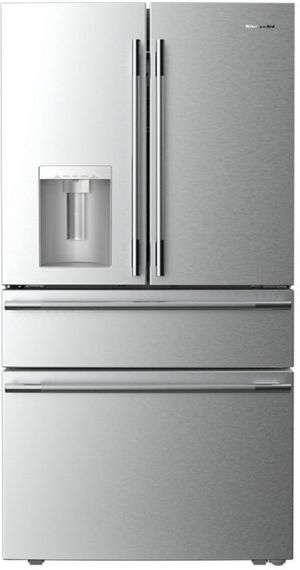
This is the four-door in the group, and the extra drawer is the whole point. The FreshChill full-width refrigerated drawer lets you set the temperature for what is actually in it, so it works as a beverage zone one week, a deli and party platter zone the next, and a meat drawer the week you bring venison home. That flexibility is what separates a four-door from a French door with a bigger price tag. You still get 28.74 cubic feet, the exterior water and ice dispenser, and the wood-look sliding storage tray. If your household alternates between entertaining and batch cooking, start here.
Top Features
- FreshChill full-width refrigerated drawer: Choose the temperature for what is in it, from beverages to platters to proteins.
- 28.74 cubic feet in a four-door layout: Large capacity split across zones instead of one undifferentiated compartment.
- Exterior water and ice: Dispensing without opening the door, which matters most in a busy kitchen.
- Wood-look sliding storage tray: Serving platters stay flat and reachable rather than stacked.
KitchenAid® 36” 20.85 Cu. Ft. Fingerprint Resistant Stainless Steel Counter Depth Side-by-Side Refrigerator with Exterior Ice and Water Dispenser

Shop Side-by-Side Refrigerators
Two things make this the galley kitchen pick. Tall narrow doors need the least swing clearance of any configuration, and counter depth pulls the cabinet back nearly flush with your counters, so a narrow aisle stays walkable even with a door open. It is also the answer when someone in the house needs freezer access every day and should not be bending into a bottom drawer to get it, because frozen items sit at eye level here. Panoramic LED lighting reaches every angle instead of leaving a dark back corner, and the exterior ice and water dispenser keeps the door closed.
Top Features
- Counter-depth side-by-side design: The smallest door swing of any layout, in a cabinet that sits nearly flush with your counters.
- Eye-level freezer shelves: Daily freezer access without bending into a drawer.
- Panoramic LED lighting: Illuminates every angle so ingredients stay visible instead of lost in the back.
- Exterior ice and water dispenser: Filtered water and ice without opening the door.
KitchenAid® 36” 20.8 Cu. Ft. PrintShield™ Stainless Steel Built-In French Door Refrigerator

This is the remodel model, and it is a different kind of purchase from the four above. Multiple installation options let you set it flush for a seamless cabinet run, overlay for a softer integrated look, or proud for a unit that stands out on purpose, which is a decision to make with your cabinet maker rather than after the countertops are in. The Signature Platinum Interior brings metallic accents and premium materials to a compartment you open several times a day, and the Preserva+ Cooling System runs multiple evaporators so nothing shares air between compartments. Plan on professional installation and a specification sheet in the cabinet shop's hands early.
Top Features
- Multiple installation options: Flush, overlay, or proud, so the refrigerator matches the cabinetry plan instead of dictating it.
- Signature Platinum Interior: Metallic accents and premium interior materials rather than a plastic-heavy compartment.
- Preserva+ Cooling System: Multiple evaporators keep air, odors, and moisture separated between compartments.
- Customizable hardware options: Handle and finish choices that coordinate with the rest of a custom kitchen.
Upgrade Your Kitchen With the Right KitchenAid Refrigerator
Configuration decides how your kitchen flows, depth decides whether the refrigerator fits the room or fights it, and preservation features decide how long the groceries you just carried in actually last. Get those three right and the finish is just the part you see.
Come open the doors. Shop refrigerators online at Furniture & ApplianceMart or visit a showroom in the Wausau, Stevens Point, Wisconsin Rapids, Marshfield, or Appleton area and measure the shelves yourself. Our appliance specialists know the model differences and what is actually in stock, our own crews handle professional installation including water line hookup and leveling, we haul the old unit away, and our service department is right here in central Wisconsin long after the sale. That is the difference between buying from an independent Wisconsin retailer and taking delivery from a national warehouse. Stop in or call with your measurements in hand, and we will narrow it down with you.
Read more:
French Door Refrigerator Buying Guide: Sizes, Features, & Top Models
How to Install a Built In Refrigerator
Frequently Asked Questions about KitchenAid Refrigerators
A KitchenAid refrigerator is worth the premium for households that cook from fresh ingredients regularly and want preservation engineering like dual evaporators, humidity-controlled crispers, and temperature-controlled pantry drawers. If your refrigerator mostly holds beverages and leftovers, a mainstream brand delivers the same cubic feet for meaningfully less money.
Counter-depth models run roughly twenty-four to thirty inches deep and sit nearly flush with cabinet fronts, while standard-depth models run roughly thirty-five to thirty-six inches deep and project several inches into the walkway. The counter-depth version of the same width typically holds several cubic feet less, so you are trading interior capacity for a flush line and a clearer path through the kitchen.
KitchenAid is a brand owned by Whirlpool Corporation, which also owns Maytag, Amana, and JennAir. Shared corporate ownership does not mean shared products, since the brands are engineered and positioned separately, but it does mean parts distribution and service networks are broad and well established.
Most full-size refrigerators give roughly ten to fifteen years of service, and premium units maintained well often reach the upper end of that range. Vacuuming the condenser coils twice a year, replacing filters on schedule, and leaving the manufacturer’s required ventilation clearance are the three habits that most affect where a given unit lands.
A common guideline is four to six cubic feet of refrigerator capacity per adult in the household, which puts most families between twenty and twenty-eight cubic feet. Width is the harder constraint, so measure your opening at its narrowest point and confirm the manufacturer’s required side, top, and rear clearances before choosing a capacity target.
Manufacturers typically recommend replacing the water filter every six months or after a set number of gallons, whichever comes first. On a private well with hard water or high iron content, filters load faster than the indicator light accounts for, so change it when water taste or dispenser flow declines rather than waiting for the light.
Why Trust Furniture & ApplianceMart?
For over 55 years, Furniture & ApplianceMart has proudly served Wisconsin and Illinois as a local, employee-owned retailer built on family values and long-term relationships. What began as a customer-first business has grown into the area’s only true one-stop shop for furniture, appliances, and mattresses.
Our mission is to improve the quality of people’s lives by making amazing rooms together. We offer trusted national brands, competitive pricing, and flexible financing options for every budget to make furnishing your home simple and stress-free. We service what we sell with repairs completed by skilled, in-house technicians you can rely on. With a meet or beat price guarantee and a commitment to exceptional service after the sale, we stand behind every purchase.
Shop at Furniture & ApplianceMart
At Furniture & ApplianceMart, you’ll find a wide selection of furniture at competitive prices. From custom furniture to top-brand mattresses and major appliances, we make it easy to shop for everything you need in one store. Ask about clearance and scratch-and-dent savings available at every location, professional delivery and installation, design consultations, appliance repair services, and convenient financing options. Visit one of our showrooms across Wisconsin and Illinois or shop online today.